Why Your Fire Certificates are Useless: A Survival Guide to U.S. Trade Shows
You’ve spent months planning and a small fortune designing the perfect trade show booth. The graphics are stunning, the layout is inviting, and you have the all-important fire certificate for your materials. You’re ready for a successful show. But then, a fire marshal walks through with a clipboard, and suddenly, your event is in jeopardy. What went wrong? That piece of paper you trusted, your fire certificate, isn’t the golden ticket you thought it was. Navigating U.S. trade show fire safety is about more than just one document; it’s about understanding a complex web of local rules.
The truth is, while your certificate is crucial, it’s just the starting point. A fire marshal’s job is to look at the total picture of safety, and there are dozens of ways a well-intentioned exhibitor can fail an inspection. From the placement of a cardboard box to the design of your booth, every detail is under scrutiny. This guide will help you understand the fire marshal’s perspective and ensure your exhibit is not only impressive but also fully compliant.
The Patchwork of Rules: Why One Size Doesn’t Fit All
First things first: there are no overarching federal fire safety regulations for exhibitor booths in the United States. Instead, safety is enforced at the state, city, and even the specific venue level. This means the rules at McCormick Place in Chicago could be different from the Javits Center in New York or the Las Vegas Convention Center.
While many jurisdictions base their codes on standards from the National Fire Protection Association (NFPA), like NFPA 101 (the Life Safety Code), the local fire marshal has the final say. They interpret and enforce these codes, and their word is law on the show floor. This variation is why what passed inspection in Orlando might get flagged in Anaheim. Your ultimate responsibility as an exhibitor is to comply with the local regulations for the specific event you are attending.
Common “Gotchas”: Why Exhibitor Certificates Get Rejected
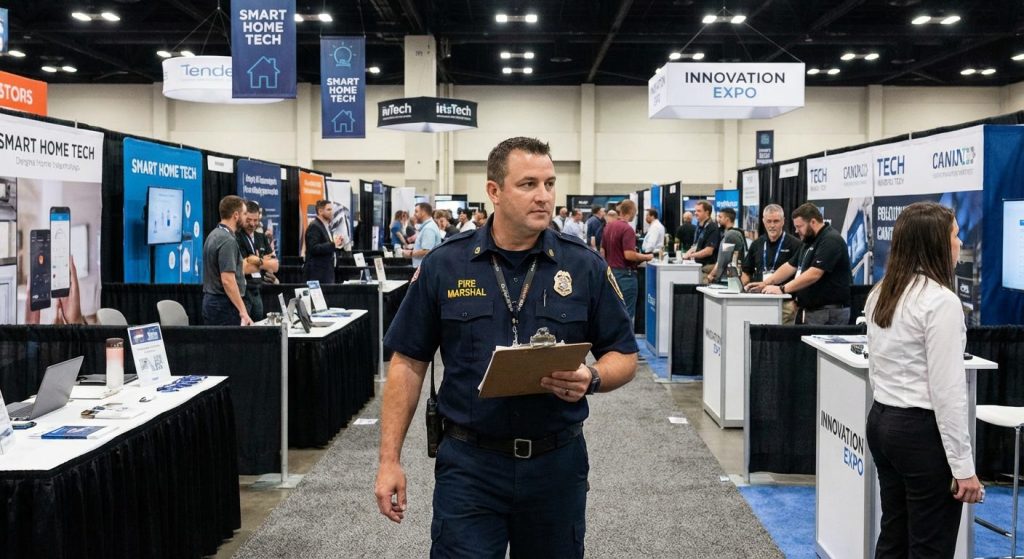
Even with a valid fire certificate in hand, a fire marshal can find plenty of reasons to halt your exhibit. These are the most common violations that catch exhibitors by surprise.
- Inadequate Certification: This is the most frequent issue. Maybe the certificate is for the wrong standard (e.g., not NFPA 701 compliant), it has expired (chemically treated fabrics often need annual re-certification), or it’s missing altogether. Self-treating materials is also generally disallowed; the certificate must come from a manufacturer or a third-party certifier.
- Prohibited Materials: Some materials simply can’t be made flame retardant effectively. Items like oilcloth, tar paper, certain plastics, and nylon are often prohibited. If your booth heavily features these, your certificate for other materials won’t matter.
- Obstruction of Egress and Safety Equipment: This is a critical safety failure. If your booth design, stored boxes, or even a literature stand blocks an aisle, exit door, or access to a fire extinguisher, fire hose cabinet, or alarm pull station, you will face an immediate rejection.
Safety equipment must be visible and accessible at all times.
- Improper Storage: That neat stack of extra brochures and empty cardboard boxes tucked behind your back wall is a major fire hazard. The fire marshal sees it as fuel waiting for a spark. Most venues prohibit storing combustible materials behind the booth. Regulations often state you can only keep a one-day supply of literature within your booth, stored safely in a container.
- Unapproved Booth Designs: If your booth is covered, has multiple levels, or is larger than a certain size (e.g., 1,000 sq ft), you likely need to submit detailed floor plans for pre-approval. These plans may even require a signature from a licensed structural engineer. A covered booth might need its own smoke detectors or sprinkler heads, as the main structure can block the venue’s system.
- Vehicle Display Errors: Showing off a vehicle? The battery must be disconnected, terminals taped, the fuel cap locked or sealed, and the fuel tank must contain minimal fuel (e.g., no more than a quarter tank or five gallons).
Surviving the Inspection: Your Proactive Checklist
Don’t wait for the fire marshal to find a problem. Use this survival checklist to prepare your trade show fire safety plan in advance.
- Get the Rules in Writing: As soon as you book your space, get the event’s specific fire safety regulations from the show organiser or venue. Don’t assume anything.
- Verify Your Materials and Certificates: Understand if your fabrics are Inherently Fire Retardant (IFR), which don’t expire, or have been chemically treated, which may require re-certification. Ensure your certificate aligns with the required standards, like NFPA 701.
- Design for Safety: Plan your booth layout with safety in mind. Keep aisles clear and maintain at least a three-foot clearance around all fire safety equipment.
- Submit Plans Early: If you have a complex or covered booth, submit your detailed plans to the fire marshal for approval weeks, or even months, in advance. Late submissions are often rejected.
- Plan Your Storage: Arrange for your empty crates and boxes to be removed by the general contractor. Keep your in-booth literature supply minimal and tidy.
By preparing for the fire marshal’s inspection with the same diligence you put into your marketing plan, you can avoid costly and stressful last-minute changes. Understanding that fire marshal regulations are about ensuring everyone’s safety helps transform the inspection process from a hurdle into a routine part of a successful trade show experience.
Reference List
- National Fire Protection Association (NFPA) – https://www.nfpa.org
- Exhibitor Online – https://www.exhibitoronline.com
- City of Chicago (McCormick Place Regulations) – https://www.chicago.gov
- San Diego Fire-Rescue Department (Convention Center Guidelines) – https://www.sandiego.gov
- GES (Global Experience Specialists) – https://www.ges.com