
I keep hearing the same thing on-site at trade shows:
“Why did our stand look amazing in the render… but feel completely different in real life?”
Or worse:
“We spent the budget, but the leads were average. What went wrong?”
If you’ve been anywhere near an expo hall recently, you’ve probably asked yourself something similar. Maybe you’re planning your next show and wondering if exhibition stand design really moves the needle, or if it’s just expensive theatre.
Here’s what I’ve seen after talking to brands, organisers, and exhibition stand builders across Europe and the US: most companies aren’t failing at marketing — they’re failing at translation. Turning a strategy into physical space is where things quietly break.
And that gap is where money disappears.
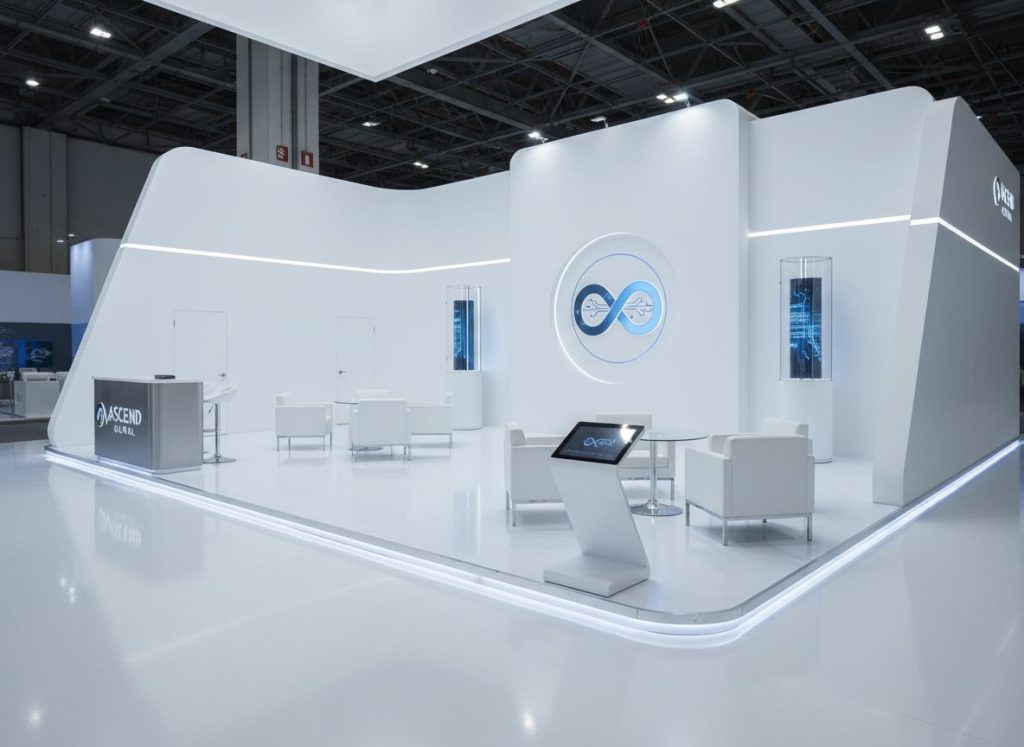
The real problem with exhibition stand design
Let’s be blunt.
Most exhibition stand design decisions are still made like it’s 2012:
- “Make it look premium”
- “Add more LED screens”
- “Bigger logo”
- “Let’s copy last year’s stand but slightly better”
It sounds reasonable. But on the show floor, it doesn’t always work.
Because exhibition halls aren’t design awards. They’re noisy, time-pressured selling environments. People walk past in seconds. Your stand has maybe 3–5 seconds to answer one question:
“Is this worth my time?”
If your exhibition stand design and build doesn’t answer that instantly, you’ve already lost half your traffic.
Others suggest it’s about creativity. I’m not fully convinced. It’s more about clarity under pressure.
Where things actually break (and no one talks about it)
From what I’ve seen reporting across multiple events, failure usually happens in three places:
1. Design without operational reality
An exhibition stand design company will often present something that looks perfect on screen. But then reality hits:
- venue restrictions
- freight delays
- union labour rules
- installation windows of 8–12 hours
Suddenly, that “simple feature wall” becomes a logistical headache.
Good exhibition stand builders think backwards. From breakdown, not just design.
2. Build quality doesn’t match intent
I’ve walked onto stands that were meant to feel “high-end tech brand”, but the join lines were visible, screens lagged, and flooring shifted slightly underfoot.
Visitors notice that instantly, even if they don’t say it.
This is where exhibition stand design and build either holds everything together or quietly undermines the brand.
3. No alignment between marketing and physical space
Marketing teams want leads. Designers want aesthetics. Sales want conversations.
But the stand? It’s often designed in isolation.
So you end up with something that looks good, but doesn’t naturally pull people into a conversation zone.
That disconnect is where ROI dies.
What actually works (based on what I’ve seen on the floor)
If I strip away all the noise, the stands that consistently perform well tend to follow a few simple patterns.
1. They prioritise flow over form
The best exhibition stand design I’ve seen doesn’t start with visuals. It starts with movement:
- Where do people enter?
- Where do they stop?
- Where do conversations happen?
- Where do they exit?
It’s almost behavioural design, not graphic design.
2. They’re built for speed, not perfection
The highest-performing brands aren’t obsessing over perfection.
They’re asking:
- Can this be built fast?
- Can it survive transport?
- Can it be reused?
That’s where modular exhibition stand design and build systems quietly outperform bespoke “one-off masterpieces”.
Less glamour. More consistency.
3. They use simplicity as a weapon
The stands that feel “busy” rarely perform well.
The ones that work usually have:
- One clear message
- One dominant visual
- One obvious entry point
That’s it.
If your exhibition stand design company is giving you five competing ideas, you probably don’t need more ideas — you need reduction.
So what should you actually do?
If I were advising a brand planning their next show, here’s the practical breakdown.
Step 1: Start with outcomes, not visuals
Don’t start with “what should it look like?”
Start with:
- How many conversations do we need?
- What type of visitor matters?
- What should staff do in the first 10 seconds of contact?
Design comes after that.
Step 2: Choose builders before design gets emotional
This sounds backwards, but it matters.
Involving exhibition stand builders early changes everything. They’ll immediately tell you:
- What’s realistic
- What’s too slow to install
- What will cost you extra on-site
That feedback saves more budget than most design tweaks ever will.
Step 3: Treat build and design as one system
The strongest performers don’t separate exhibition stand design and build.
They treat it as a single operating system:
- Design = how it attracts attention
- Build = how it survives reality
- logistics = how it arrives intact
- Staff layout = how it converts interest into leads
When those align, things just work better.
Not perfect. Just better enough to matter.
Step 4: Pick partners who think in ROI, not renderings
A strong exhibition stand design company won’t just show you visuals.
They’ll ask:
- What’s the cost per lead target?
- How many shows will this stand run?
- What can be reused?
If they don’t ask those questions, you’re probably buying art, not performance.
Final thought: Exhibition stands are not art projects
Here’s what I keep coming back to after every show:
Most brands don’t need more creative exhibition stand ideas.
They need fewer assumptions.
Because once you step into a hall with 500 competing booths, creativity without clarity just becomes noise.
And noise doesn’t convert.
A strong exhibition stand design isn’t the one people admire.
It’s the one they walk into without thinking — and leave as a lead.
That’s the real game.
References
- UFI Global Association of the Exhibition Industry – Trade Show Effectiveness Reports
- CEIR (Centre for Exhibition Industry Research) – Exhibition & Attendee Behaviour Studies