Why do some brands pull crowds at trade shows while others sit there hoping for footfall?
Why does one stand generate leads all day, while the one next door — maybe with a bigger budget — struggles?
I’ve walked enough exhibition halls to notice a pattern. It’s rarely the biggest stand that wins. It’s the one that was thought through.
And that’s where bespoke exhibition stand design keeps coming up.
A lot of exhibitors still treat stand design as decoration. Graphics go up. Furniture goes in. Lights get switched on. Done.
That approach may have worked years ago. It doesn’t work well now.
Visitors are overloaded. Buyers move fast. Decision-makers judge in seconds.
A stand today has to do more than exist. It has to perform.
The Real Problem: Most Exhibition Stands Are Built Backwards
Many companies start with structure first.
“How many square metres do we have?”
“What can we fit in?”
“What’s the cheapest contractor quote?”
Fair questions. But maybe the wrong starting point.
The better question is:
What do you need the stand to do?
Generate meetings?
Launch a product?
Support distributor recruitment?
Create brand authority in a crowded hall?
Those goals shape everything.
That’s why experienced teams often begin with strategy before drawings. A strong bespoke exhibition stand design and build process usually starts with objectives, traffic flow, visitor psychology, and commercial outcomes — not just renderings.
And honestly, that’s where weaker projects often fall apart.
They look decent.
But they don’t convert.
Design That Looks Good vs Design That Works
There’s a difference.
A pretty stand can still be ineffective.
A high-performing stand tends to include things others sometimes overlook:
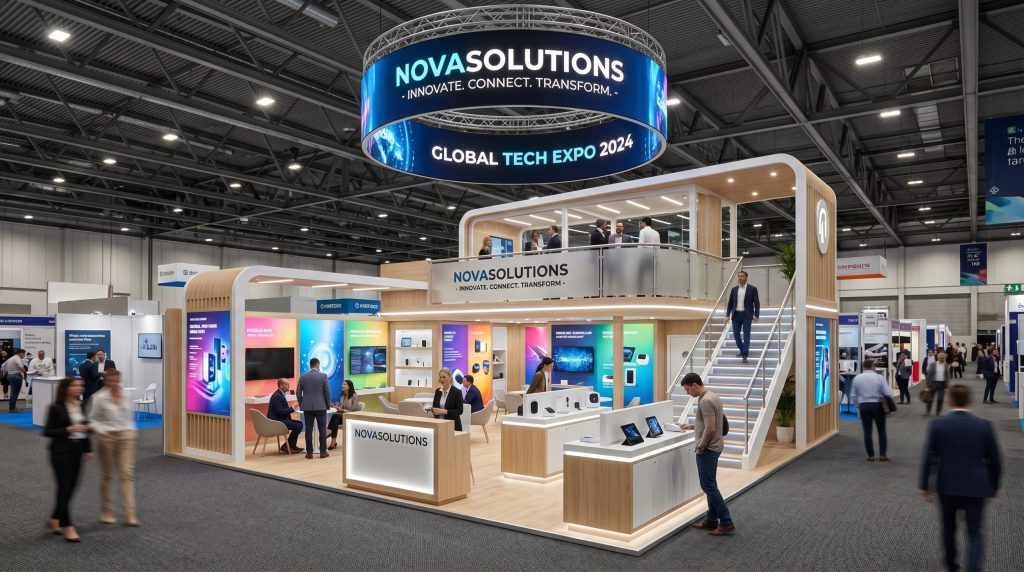
- Open sightlines that pull visitors in
- Zoning for demos, meetings, and casual conversations
- Messaging visible from a distance
- Smart lighting that directs attention
- Integrated lead capture points
- Modular features that can be reused across events
Some suggest this is where custom exhibition stands outperform standard systems.
Not because custom always means bigger.
Because custom often means intentional.
That’s the advantage of bespoke exhibition stand design when done well. It aligns architecture with sales.
And that changes the economics.
The Cost Question Everyone Asks
“Is bespoke too expensive?”
Reasonable concern.
But that question can be misleading.
Because cost without return means nothing.
A £35,000 stand that produces a qualified pipeline may outperform a £12,000 booth that generates little.
I’ve heard bespoke exhibition stand contractor teams frame it this way:
Don’t measure spend.
Measure cost per lead.
Measure cost per opportunity.
Measure revenue per square metre.
That shifts the conversation.
Suddenly, design isn’t overhead.
It becomes part of demand generation.
Why Design and Build Under One Partner Often Works Better
Fragmentation causes problems.
The agency does concept.
Fabricator interprets it.
The installer improvises on-site.
Things get lost.
Deadlines slip.
Costs creep.
That’s partly why integrated bespoke exhibition stand design and build models have grown.
One team owns concept, engineering, production, and delivery.
Fewer handoffs.
Less confusion.
Sometimes fewer surprises at 10 p.m. during the build-up.
And if you’ve ever stood in an empty hall the night before opening, watching contractors fix avoidable mistakes, you know how valuable that can be.
What Buyers in London Are Looking For Now
The market has shifted, especially around bespoke exhibition stand London projects.
Clients aren’t only asking for dramatic structures anymore.
They’re asking for:
- Sustainable materials
- Reusable modular systems
- Faster install times
- Data-driven visitor engagement
- Hybrid spaces for live and digital content
Some London contractors say clients increasingly want stands built for multiple show cycles, not single-use displays.
That matters.
Because exhibition ROI is moving beyond one event.
It’s becoming portfolio thinking.
The Contractor Decision Is Bigger Than Most Firms Realise
Choosing a bespoke exhibition stand contractor is often treated like procurement.
Compare quotes.
Pick the cheapest.
Move on.
Risky move.
Because contractors don’t just build stands.
They affect:
- Project timelines
- Compliance
- Visitor experience
- Structural safety
- Brand perception
A weak contractor can turn strong creativity into operational chaos.
A strong one often improves the concept.
That’s a difference many buyers only discover after a bad show.
What Strong Contractors Tend to Have in Common
When I speak with exhibitors after successful events, they often mention similar traits.
Good partners usually offer:
1. Strategy before design
They ask commercial questions first.
2. In-house production capability
Less outsourcing often means more control.
3. Experience across venues
Venue regulations can derail projects fast.
4. Reusable design thinking
Better long-term economics.
5. Clear project management
This matters more than flashy pitch decks.
A credible bespoke exhibition stand contractor often feels boring in the best way.
No drama.
Things just work.
That’s valuable.
Where Bespoke Can Go Wrong
Custom doesn’t automatically mean effective.
Sometimes exhibitors overdesign.
Huge structures.
Too much technology.
No clear story.
Visitors walk past confused.
Others overspend on features no one interacts with.
Maybe that giant LED wall looks impressive.
But if it doesn’t support engagement, what’s it doing?
Good bespoke exhibition stand design often removes friction.
It doesn’t add noise.
That distinction matters.
A Better Way to Think About Exhibition Investment
Maybe this helps.
Don’t ask:
“What should our stand cost?”
Ask:
“What outcome are we buying?”
That leads to smarter decisions about:
- Custom build vs modular exhibition systems
- Double-deck stands vs island booths
- Portable elements vs permanent assets
- Experiential design vs product-led displays
Different shows need different answers.
And maybe that’s the point.
There is no universal “best” stand.
Only fit.
The Opportunity Most Brands Still Miss
Here’s what surprises me.
Many firms still spend heavily on paid traffic, outbound and content marketing, then underinvest in exhibitions where prospects physically show up ready to talk.
That disconnect feels odd.
Trade shows remain one of the few places where attention is concentrated.
And attention is expensive.
A strong bespoke exhibition stand design and build strategy can turn that attention into a pipeline.
That’s not decoration.
That’s commercial infrastructure.
Suggestion: Treat Your Stand Like a Revenue Asset
If I were advising an exhibitor reviewing suppliers right now, I’d probably ask:
- What commercial outcome is this stand designed to support?
- Can this design be reused across shows?
- Does the contractor think strategically, or just build?
- Are we buying aesthetics, or buying performance?
- If this stand doubled the lead volume, would the cost still feel high?
That tends to reframe the decision.
And maybe it should.
Because the best bespoke exhibition stand London projects rarely start with “make us look impressive”.
They start with:
“How do we win this floor?”
That’s a different conversation.
And usually, a better one.
References
- Harvard Business Review — Articles on experiential marketing and B2B event strategy
- UFI (Global Association of the Exhibition Industry) — Global exhibition industry reports
- ESSA UK — Guidance on exhibition stand construction and best practice