
While often used interchangeably in everyday conversation, the terms exhibition, expo, trade show, and trade fair actually carry distinct meanings, primarily differentiated by their target audience, scope, and objectives. Understanding these nuances is crucial for businesses looking to participate or individuals seeking to attend. At the heart of all these events are “booths,” the individual display spaces that companies utilize to showcase their offerings and engage with attendees. This post will clarify the specific characteristics of each, offering a comprehensive guide to these dynamic events.
Key Concepts
Each term describes a type of organized gathering where products, services, or information are presented. The core differences lie in who they aim to attract and what they aim to achieve.
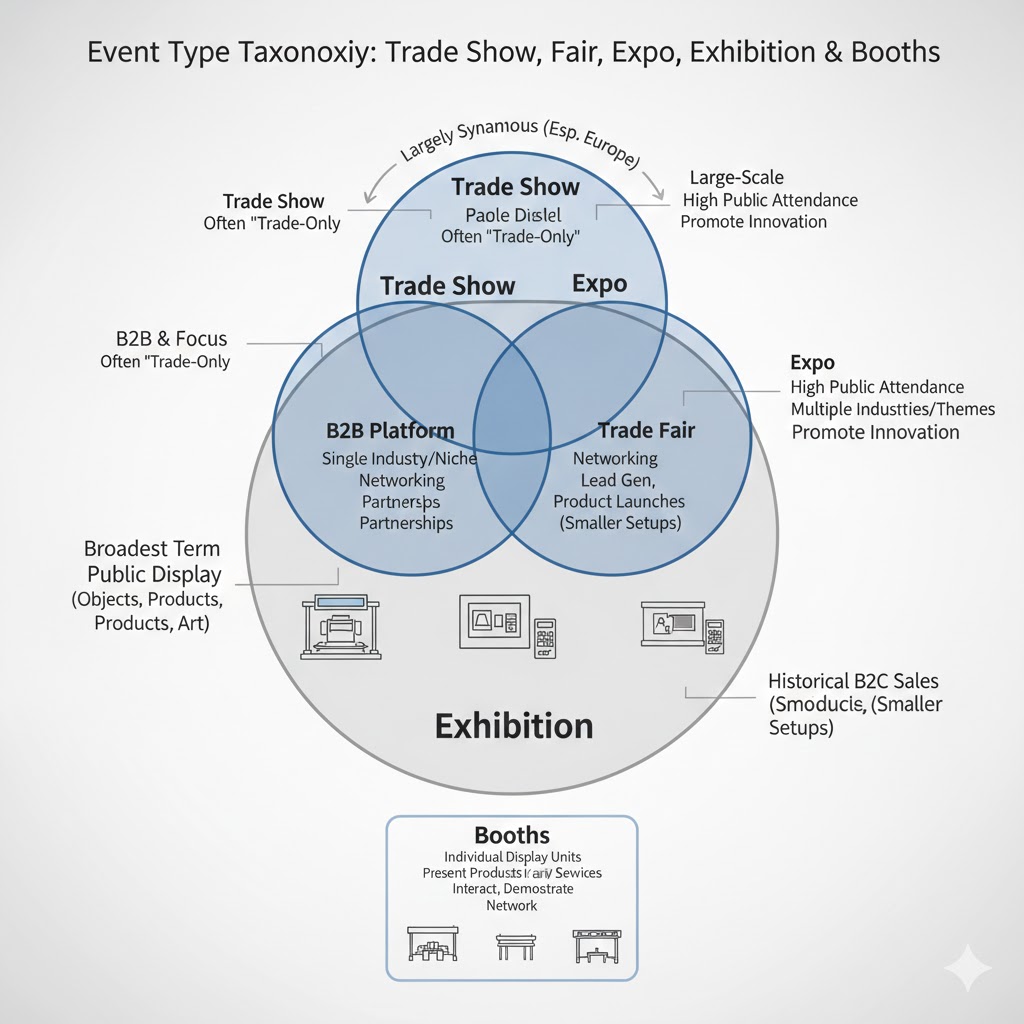
Trade Show: A business-to-business (B2B) event narrowly focused on a single industry or niche sector. Its main objectives include networking among industry professionals, generating leads, forging partnerships, and launching new products and services to buyers and decision-makers. Sales are typically not the primary goal; instead, the emphasis is on establishing long-term collaborations. Many trade shows are “trade-only,” meaning they are not open to the general public.
Trade Fair: This term is largely synonymous with “trade show,” particularly in Europe and other international contexts. Historically, trade fairs might have had a stronger consumer focus, serving as marketplaces for direct sales, often with smaller display setups. However, modern trade fairs, much like trade shows, now predominantly function as B2B platforms for companies within a specific industry to exhibit products, meet potential customers and suppliers, study competitors, and analyze market trends. They can be either public or restricted to trade professionals.
Expo: Short for “exposition,” an expo is typically a large-scale event with a broader scope than a specialized trade show or fair. Expos aim for high attendance and maximum public attention, often appealing to a diverse audience, including both businesses (B2B) and consumers (B2C). They may span multiple industries or themes and frequently incorporate educational sessions and entertainment elements. The focus is on promoting innovation, highlighting trends, and facilitating business opportunities through extensive networking.
Exhibition: This is the broadest term of the four, referring to any organized public display of objects, products, services, or artistic works. While it can certainly encompass trade-focused events, it also includes art displays, museum exhibits, and cultural showcases. In a business context, exhibitions are often B2B, where professionals introduce new products, sometimes with demonstrations. Like trade shows, direct sales are not the main goal; visual promotion and demonstration are prioritized, alongside building a strong brand image.
Booths: These are the essential, individual display units rented or constructed by companies or organizations within any of the aforementioned events. A booth serves as a dedicated space for exhibitors to present their products or services, interact with visitors, conduct demonstrations, and engage in networking. Booth designs and sizes vary widely, from simple tables to elaborate, custom-built structures, depending on the event, budget, and specific marketing objectives.
Historical Context and Evolution
The concepts behind these events have a long history, evolving from ancient marketplaces to sophisticated modern platforms.
Historically, trade fairs emerged as early as the Middle Ages, serving as vital commercial hubs where merchants from different regions would gather to sell goods directly to consumers. These early fairs were often tied to religious festivals or harvest times, fostering both trade and social interaction. Over centuries, as trade routes expanded and industries specialized, these general marketplaces began to evolve.
The distinction between consumer-focused sales and industry-specific networking gradually sharpened. Trade shows began to formalize in the 19th and 20th centuries with the rise of industrialization, becoming dedicated spaces for manufacturers and suppliers to present innovations to business buyers rather than the general public. This shift emphasized lead generation, industry collaboration, and brand building over direct retail sales.
Expositions (or Expos) also have deep roots, famously exemplified by the World’s Fairs that began in the mid-19th century. These grand events were designed to showcase technological, industrial, and artistic achievements on a global scale, attracting millions of visitors from all walks of life. Their broad, often multi-industry appeal and emphasis on innovation and public engagement distinguish them historically from the more commercially focused trade events.
The term exhibition has always been the most encompassing, referring broadly to any public display. Its use in a business context has solidified as a professional setting for product launches and demonstrations, reflecting the broader evolution of marketing and B2B engagement strategies.
Today, while the historical distinctions provide a framework, modern usage often blurs the lines. A “trade fair” in Europe might be functionally identical to a “trade show” in North America. The key differentiating factors now often come down to the specific goals, target audience, and scale of the organizing body.
Current Relevance and Impact
In the digital age, these physical events continue to hold significant relevance, providing unique opportunities that online platforms cannot fully replicate.
- Unparalleled Networking: Trade shows, fairs, and expos remain critical for face-to-face interaction, allowing professionals to build relationships, meet potential clients or partners, and engage in informal discussions that often lead to new business opportunities. This direct engagement fosters trust and understanding far more effectively than digital communication alone.
- Product Launches and Demonstrations: These events offer an ideal stage for companies to introduce new products and services to a targeted audience. Attendees can experience products firsthand, ask questions directly to experts, and see live demonstrations, which is particularly vital for complex or innovative offerings.
- Market Research and Competitive Analysis: Businesses leverage these gatherings to gauge market interest, gather feedback, and observe competitor strategies and innovations. They provide a snapshot of current industry trends and future directions.
- Brand Building and Visibility: Participating in a prominent trade show or expo significantly enhances a company’s visibility and strengthens its brand image within its industry. A well-designed booth can leave a lasting impression on potential customers and partners.
- Educational Opportunities: Many modern events incorporate seminars, workshops, and keynote speeches, offering valuable insights into industry best practices, emerging technologies, and market challenges. Expos, in particular, often have a strong educational component.
- Economic Impact: These events contribute significantly to local economies through tourism, hospitality, and event-related services, showcasing their importance beyond direct business transactions.

The role of booths remains central to the success of any of these events. They are not merely display areas but strategic tools for engagement, providing a physical embodiment of a brand and a focal point for interactions. The evolution of booth design reflects current trends in experiential marketing, with many becoming highly interactive, technologically advanced, and designed to create memorable experiences for attendees.
In essence, whether it’s a specialized trade show, a broader expo, or a historical trade fair, these events collectively form a vital ecosystem for commerce, innovation, and professional development in an increasingly interconnected world.
Final Thoughts
While the terms “exhibition,” “expo,” “trade show,” and “trade fair” can be confusing due to their overlapping nature and regional usage, understanding their core distinctions—primarily audience, scope, and objectives—is key. Each serves a unique purpose in the landscape of business and public engagement, with the individual exhibitor’s “booth” acting as the fundamental interface for connection and display. In a world where digital interactions are pervasive, these physical gatherings continue to thrive by offering invaluable opportunities for direct engagement, tangible product experience, and deep professional networking.