Let’s be honest for a second.
How many leads from your last B2B trade show actually turned into revenue?
Not scans. Not “great conversations.”
Closed deals.
And if the answer makes you uncomfortable, you’re not alone.
I’ve spent the past few years speaking with exhibitors, sales teams, and stand builders across Europe and the US. The pattern is consistent: companies invest heavily in B2B trade show presence—design, logistics, travel—but quietly accept weak conversion as “just how it is.”
Maybe it is. Or maybe the gap isn’t traffic—it’s what happens after someone steps into your stand.
The Real Problem Isn’t Lead Generation
Most teams still treat a B2B trade show like a top-of-funnel activity.
Get attention.
Scan badges.
Send a follow-up email.
Hope something sticks.
But here’s the friction point: trade shows compress the entire sales cycle into a few days. If you don’t adapt to that reality, your pipeline leaks immediately.
From what I’ve seen, three issues come up again and again:
- Conversations stay surface-level
- Qualification is vague (or skipped entirely)
- Follow-ups feel generic and delayed
So while the booth looks impressive, the conversion system behind it is… thin.
Rethinking the Funnel: From Traffic to Intent
At a good B2B trade show, you’re not starting from zero.
People walk in already curious—sometimes even actively looking.
That changes the game.
Instead of treating every visitor as a lead, the better teams treat them as potential buyers at different levels of intent.
A simple mental model I’ve seen work:
- Cold curiosity → browsing, learning
- Active interest → comparing solutions
- Buying intent → ready to evaluate seriously
The mistake? Treating all three the same.
If anything, conversion starts with recognising who you’re actually talking to—not just collecting their details.
What High-Converting Teams Do Differently
1. They Qualify Early (Without Making It Awkward)
No one wants to be interrogated on a show floor. But avoiding qualification entirely is worse.
The better teams use conversational triggers:
- “What are you currently using?”
- “What made you stop here today?”
- “Are you exploring options or actively planning a change?”
Simple, natural, but revealing.
If someone’s just browsing, fine—educate.
If they’re evaluating, shift gears.
If they’re ready, don’t slow things down.
2. They Design Conversations, Not Just Booths
There’s a lot of focus on stand design—and fair enough, it matters.
But conversion often comes down to what happens in minute two, not minute one.
Some teams script this deliberately:
- Opening hook (why stay?)
- Problem framing (why care?)
- Proof (why trust?)
- Next step (why act now?)
Not robotic. Just intentional.
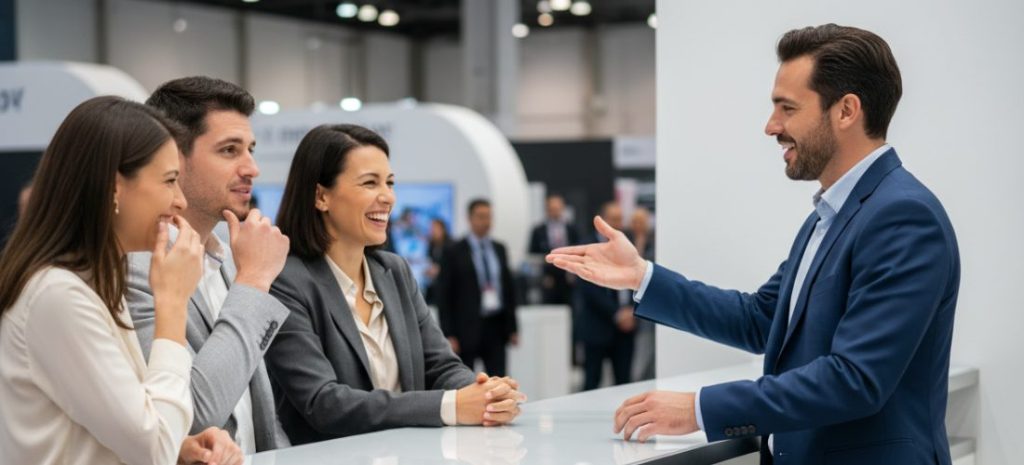
Others suggest that even small tweaks—like removing physical barriers or creating semi-private discussion areas—can significantly increase meaningful conversations.
3. They Anchor Value with Proof, Not Promises
At most B2B trade shows, claims sound the same:
“We improve efficiency.”
“We reduce costs.”
It blends.
What cuts through is specificity:
Show real stories. What problem did the client have? What solution did you provide? What changed after working with you?
Use numbers. Conversion rates, cost savings, lead quality improvement — make the impact visible and measurable.
Be specific. Who is this for? What scenario does it solve? Help prospects quickly see themselves in the solution.
I’ve seen exhibitors quietly double their conversion rates just by bringing sharper case studies into conversations.
No more slides—better proof.
4. They Don’t Wait to “Follow Up Later”.
This might be the biggest miss.
If someone shows real buying intent at a B2B trade show, delaying action kills momentum.
High-performing teams do at least one of these on the spot:
- Book a post-show call
- Send tailored information immediately
- Introduce a technical or sales lead right there
It’s not aggressive—it’s responsive.
If someone is ready, meeting them next week instead of next month matters.
5. They Treat Follow-Up as a Continuation, Not a Restart
Most follow-up emails feel like this:
“Great to meet you. Here’s our brochure.”
Which, frankly, resets the conversation to zero.
Better follow-ups reference specifics:
- “You mentioned scaling production in Q3…”
- “Here’s the case study similar to your use case…”
It signals attention—and keeps momentum alive.
Maybe it’s obvious. But in practice, it’s surprisingly rare.
The Often-Ignored Layer: Internal Alignment
One thing I didn’t expect when digging into this topic:
conversion issues often start before the show even begins.
Marketing wants leads.
Sales wants qualified opportunities.
Booth staff just want to survive three long days.
Without alignment, you get mixed signals:
- Who counts as a “good lead”?
- What happens after the scan?
- Who owns the next step?
If those answers aren’t clear, conversion drops—no matter how strong your presence is.
So… What Actually Moves the Needle?
If I had to simplify everything I’ve seen into a few practical shifts:
- Stop measuring success by lead volume alone
- Train teams to identify intent, not just interest
- Build conversations that naturally lead somewhere
- Act quickly when buying signals appear
- Follow up like a human, not a template
None of this is revolutionary.
But in the context of a B2B trade show, execution is what separates busy booths from profitable ones.
A Final Thought
There’s a quiet assumption in the industry that trade shows are about visibility first, conversion second.
I’m not sure that holds anymore.
If anything, the cost pressure around exhibiting is forcing a shift. Companies are starting to ask harder questions:
- “What did we actually close?”
- “Which conversations turned into revenue?”
And maybe that’s a good thing.
Because when you look closely, a B2B trade show isn’t just a marketing channel.
It’s one of the few places where attention, intent, and timing collide in real life.
If you treat it that way, conversion stops being a mystery—and starts becoming a system.