How many times have you stood on a half-built stand, looked up at exposed rigging, and thought: “Are we actually safe here?”
Or worse—“Are we about to trip the entire hall’s power?”
If you’ve spent any time in exhibition construction, you already know the truth: most on-site risks don’t come from dramatic failures. They come from small oversights. A cable run that wasn’t planned. A load that wasn’t calculated. A timeline that got squeezed.
I’ve walked enough show floors during build-up days to see the pattern. The pressure builds. Deadlines tighten. And safety—especially around power—quietly becomes “someone else’s problem.”
It isn’t.
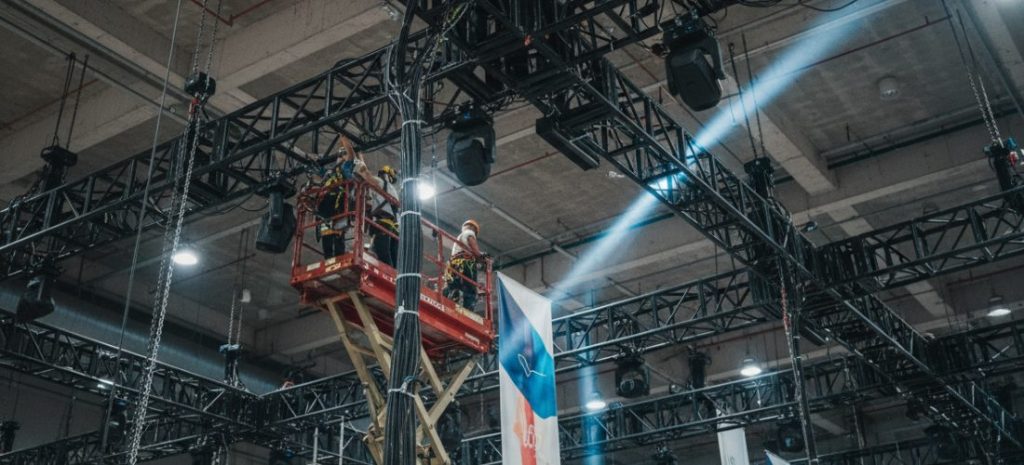
The Real Problem: Speed vs. Safety in Exhibition Construction
Let’s call it what it is.
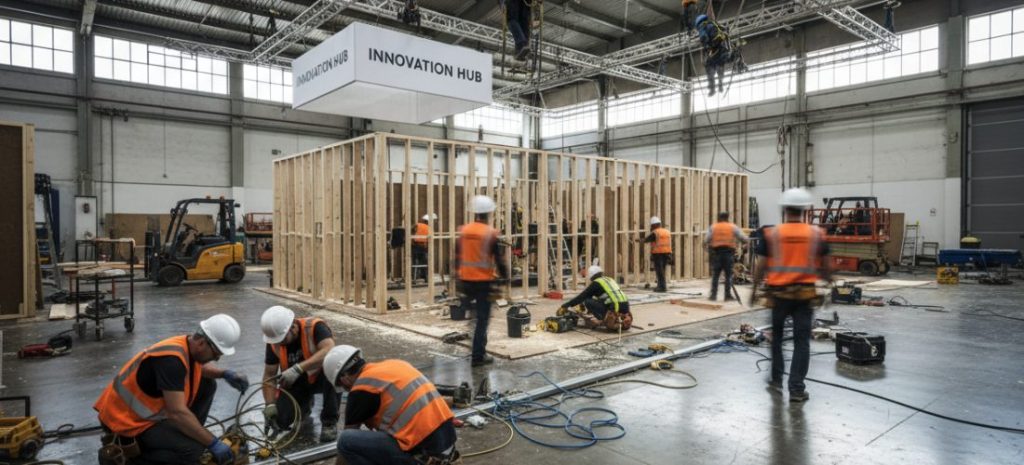
Exhibition construction is a race.
You’ve got limited access windows, union rules, venue constraints, and a client who still wants last-minute changes.
So teams prioritise what’s visible:
- Structure up on time
- Graphics installed
- Lighting looks good
What gets deprioritised?
- Load calculations
- Cable management
- Power distribution planning
And that’s where things start to slip.
Some contractors assume the venue power is “plug-and-play.” Others overspec everything just to be safe—which creates a different problem: inefficiency, higher cost, and sometimes overloaded circuits anyway.
Power Load Management: The Silent Risk
Here’s the part that doesn’t get talked about enough.
Power isn’t just a technical detail in exhibition construction—it’s a shared resource.
And in most venues, it’s already under pressure.
What actually goes wrong?
From what I’ve seen on-site, it usually comes down to three issues:
If you’re lucky, you trip a breaker.
If you’re not, you risk overheating cables or damaging equipment.
Safety in Exhibition Construction Isn’t Just Compliance
A lot of teams treat safety like a checklist:
- Fire-rated materials? ✔
- Certified electrics? ✔
- Risk assessment document? ✔
But real safety on-site feels different. It’s active, not static.
It shows up in decisions like:
- Not running cables under loose flooring
- Not stacking equipment near heat sources
- Not ignoring load limits just to “make it work”
Some project managers I’ve spoken to say the same thing:
“Most issues weren’t surprises—we just didn’t act early enough.”
What Better Teams Do Differently
After a few years covering exhibition construction projects across different markets, the stronger teams tend to follow a similar playbook.
1. They Plan Power Early (Not After Design)
Power isn’t an add-on. It’s part of the design.
That means:
- Mapping all equipment loads upfront
- Factoring in peak usage, not just average
- Aligning with venue specifications early
If the design changes, the load plan changes. No exceptions.
2. They Build for Installation, Not Just Aesthetics
Some booth designs look great on paper but create chaos on-site.
Better teams ask:
- Where do cables run?
- How accessible are connections?
- Can this be installed without risk?
Because if installation is messy, safety usually is too.
3. They Over-Communicate with the Venue
Venues aren’t just service providers—they control critical infrastructure.
Smart exhibitors:
- Confirm available power capacity
- Understand distribution limits
- Coordinate load schedules during peak build times
Others assume. That’s where problems start.
4. They Assign Responsibility (Clearly)
This one’s simple but often ignored.
Who owns:
- Load calculation?
- Cable routing?
- Final power checks?
If the answer is “everyone,” it usually means no one.
The Cost of Getting It Wrong
Let’s be practical.
Poor power load management in exhibition construction doesn’t just create safety risks—it creates business problems:
- Delays during build-up
- Equipment failure during live demos
- Unexpected costs from emergency fixes
- Reputation damage with organisers and clients
And sometimes, the issue doesn’t show up until the show opens—which is the worst possible moment.
A More Grounded Way to Think About It
Maybe this is the simplest way to frame it:
If your booth relies on power to create experience, then power is part of your core strategy—not a technical afterthought.
Some teams get this early. Others learn it the hard way.
Final Thought
Every exhibition construction project balances speed, cost, and quality. Safety and power management sit right in the middle of that triangle.
Ignore them, and they’ll show up anyway—usually at the worst time.
Plan for them, and most of the “unexpected issues” stop being unexpected.