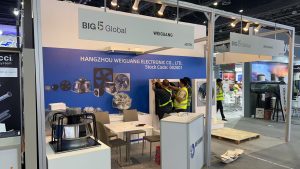
Investing in a premium modular exhibition booth is fast becoming the ultimate litmus test for savvy international B2B marketers. Every year, thousands of marketing directors face the exact same nightmare. You wire £50,000 to an overseas contractor for a custom-built exhibition stand. It looks incredible for three days. Then, the minute the hall closes, you watch a teardown crew attack it with crowbars and throw your entire budget straight into a dumpster.
That’s not just environmental negligence; it’s a straight-up cash leak.
In an era where improving your international trade show marketing ROI is under the microscope, spending half your annual marketing budget on a three-day temporary timber structure makes zero business sense. The problem isn’t the exhibition itself; it’s our stubborn, old-school attachment to the “build-and-burn” model.
The Hidden Drag on Your Exhibition Budget
If you track your numbers closely, you already know that raw material costs and local labor rates in major exhibition hubs like Frankfurt, Las Vegas, or Dubai have gone through the roof. A traditional custom build requires days of high-risk installation, specialized on-site carpenters, and endless rounds of painting. If a single flight gets delayed or a panel cracks on the logistics truck, your opening morning is ruined.
Maybe you’ve noticed a few savvy competitors showing up with sleek, premium setups that somehow go up in half the time with zero fuss. What are they doing differently?
They’ve quietly shifted to an adaptable modular exhibition booth system.
The Real Economics of Reusability
Let’s look at the actual numbers, because that’s all that matters. A cost-effective modular booth design admittedly requires a higher upfront capital expenditure. There is no hiding that. If you only do one small local show every five years, stick to a basic rental. But if you plan to exhibit at multiple overseas shows over a 24-month cycle, the math completely flips.
- Logistics and Freight: Lightweight aluminium frames pack flat into compact crates. A well-engineered modular exhibition booth ensures you aren’t paying ridiculous fees to fly tonnes of heavy MDF board across the ocean or haul it via expensive freight forwarders.
- Labor Efficiency: A standardized modular exhibition booth system doesn’t need a massive team of carpenters. It needs a small setup crew with a few hex keys. This can easily chop 30% to 50% off your on-site labor bill, meaning you spend less time arguing over overtime rates with local union workers.
- Waste Mitigation: If your board of directors is asking how to reduce exhibition construction waste to align with corporate sustainability goals, this is the low-hanging fruit. When you deploy a reusable modular exhibition booth, nothing gets thrown away at 5:00 PM on closing day. You simply swap the tension fabric graphics or reconfigure the layout for the next city.
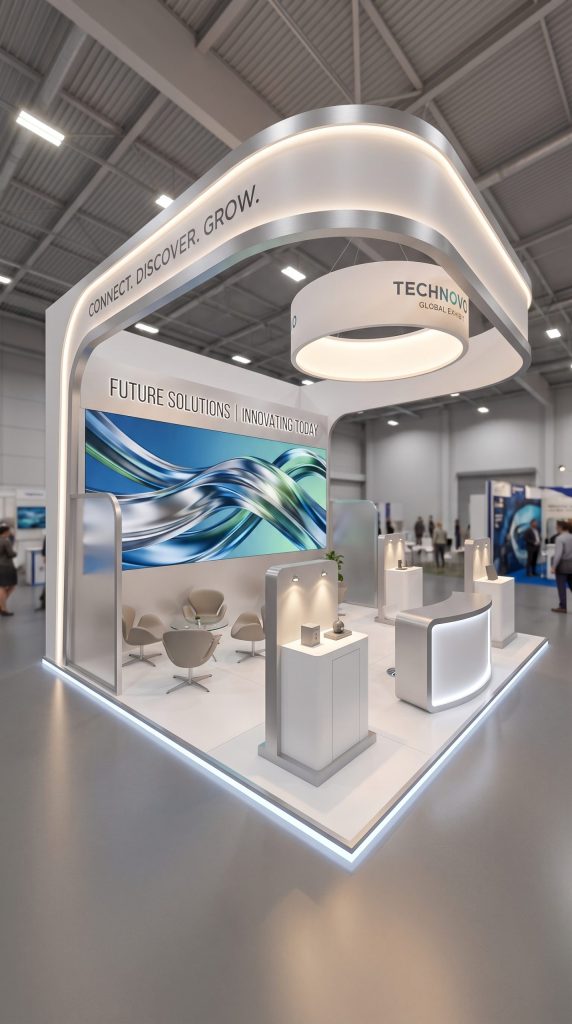
Others suggest that modular means “boring” or “cookie-cutter.” If you bought a cheap, generic pop-up wall back in 2012, that might be true. But today’s structural engineering allows for seamless integrated LED video walls, cantilevered meeting rooms, and high-end matte finishes that look completely bespoke. If done right, the prospect walking down the aisle cannot tell it’s a modular exhibition booth; your accountant definitely can.f done right, the prospect walking down the aisle cannot tell it’s modular; your accountant definitely can.
The Playbook for Shifting to Modular
If you want to protect your marketing margins without looking cheap on the show floor, this is the exact execution strategy:
- Audit Your 24-Month Show Calendar: Don’t design for just the next upcoming event. Look at every single show you have lined up globally.
- Standardize Your Core Framework: Work with an exhibition partner to design a master sustainable trade show display framework (say, a 6m x 6m island footprint) that can easily be broken down or reconfigured into smaller 3m x 6m inline stands.
- Own the Hardware, Rent the Local Support: Own the core structural frames of your modular exhibition booth so they sit on your asset sheet, but utilize global supplier networks to handle the local storage, transport, and graphics printing near the venue.
It’s a simple formula: stop paying to build things you don’t keep. Switch your budget from disposable materials to scalable infrastructure, and you win the ROI game before the doors even open.
References
- Harvard Business Review (2024) – “The New Logistics Reality for International B2B Marketing.”
- Exhibition Intelligence Report (2025) – “Cost Mitigation Strategies in Western European Trade Shows.”
- Global ESG Standards Board – “Frameworks for Supply Chain and Event Material Reusability.”