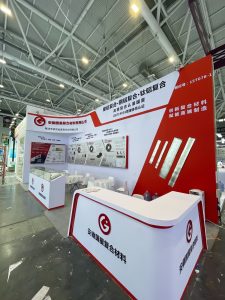
Nigeria exhibition booth builder selection for Lagos and Abuja expos in 2026 hinges on three things: backup power planning for the daily load-shedding, bonded-warehouse logistics through Apapa or Tin Can Island port, and SONCAP-compliant product display. The West African exhibition market runs on the same trio of constraints, and a Nigeria exhibition booth builder that ignores any one of them will burn the budget on the show floor.
Nigeria exhibition booth builder briefs that win in 2026 share four traits: a generator-ready electrical plan, NAFDAC-aware product display for cosmetics and health goods, on-site Yoruba or Igbo-speaking staff, and a freight forwarder that pre-clears cargo at the Lagos port free zone. The venue, cost and timeline figures below come from NeoBooths' actual 2026 Nigerian builds, and the five pitfalls below keep burning exhibitor budgets — all drawn from 18-year track record in the Africa exhibition booth building market and our recent South Africa exhibition booth builder projects across CTICC and SCC.
Why Nigeria is West Africa's largest and most strategic exhibition market
Nigeria is the largest economy in Africa and home to the most concentrated pool of B2B buyers on the continent. Lagos, with 22 million residents and a metro GDP larger than Kenya's national output, hosts more international trade shows than any other West African city. The Lagos International Trade Fair Complex (ITFC) alone runs 200+ shows each year. Abuja, the federal capital, absorbs the government procurement and ECOWAS policy events. Port Harcourt, Kano, and Kaduna round out a network of secondary cities that makes Nigeria the single most diversified exhibition market in Africa.
For a Nigeria exhibition booth builder, this means four things in 2026: the average order value per square metre is 20-30% higher than Nairobi or Accra (because most exhibitors are pre-funded by multinational procurement budgets), the demand for power-generator-backed booths is a default rather than an upgrade, SONCAP and NAFDAC product-display rules apply to most consumer and industrial goods, and a bonded-warehouse logistics chain is the single biggest cost lever (it cuts 15-25% off door-to-booth cost when done right).
Top venues and trade shows for a Nigeria exhibition booth builder in 2026
- Lagos International Trade Fair Complex (ITFC), Ojo — flagship venue for the annual Lagos International Trade Fair (September-October, 200,000+ visitors) and the West Africa Automotive Show. Direct access to the Lagos-Badagry Expressway freight corridor.
- Eko Convention Centre, Victoria Island — Africa's most-attended convention venue for B2B and B2G events. Hosts the Nigeria Oil & Gas Conference, Lagos Fashion Week, and the West Africa Power Summit.
- Abuja International Conference Centre (ICC) — federal-government flagship venue. Hosts the Nigeria Infrastructure Summit, the ECOWAS Investment Forum, and the Nigeria Mining Week.
- Oriental Hotel, Lekki — premium venue for high-end private-label product launches and tech demo days (50-200 attendee scale).
- Landers 88, Lekki — newly opened, well-suited for B2C product activations and consumer-electronics trade shows targeting the Lagos Island market.
For a Nigeria exhibition booth builder, venue choice shapes the build: ITFC and Abuja ICC require structural certification and on-site union labour; Eko Convention Centre enforces strict load-in windows (04:00-09:00 WAT) which a Nigeria exhibition booth builder must plan around; Landers 88 is suited to quick-install modular booths because the venue has no rigging ceiling.
What "Nigeria-ready" booth design actually means
Booths that perform in Lagos are not the same as booths that perform at IFA Berlin. A serious Nigeria exhibition booth builder plans for four realities the rest of the world ignores:
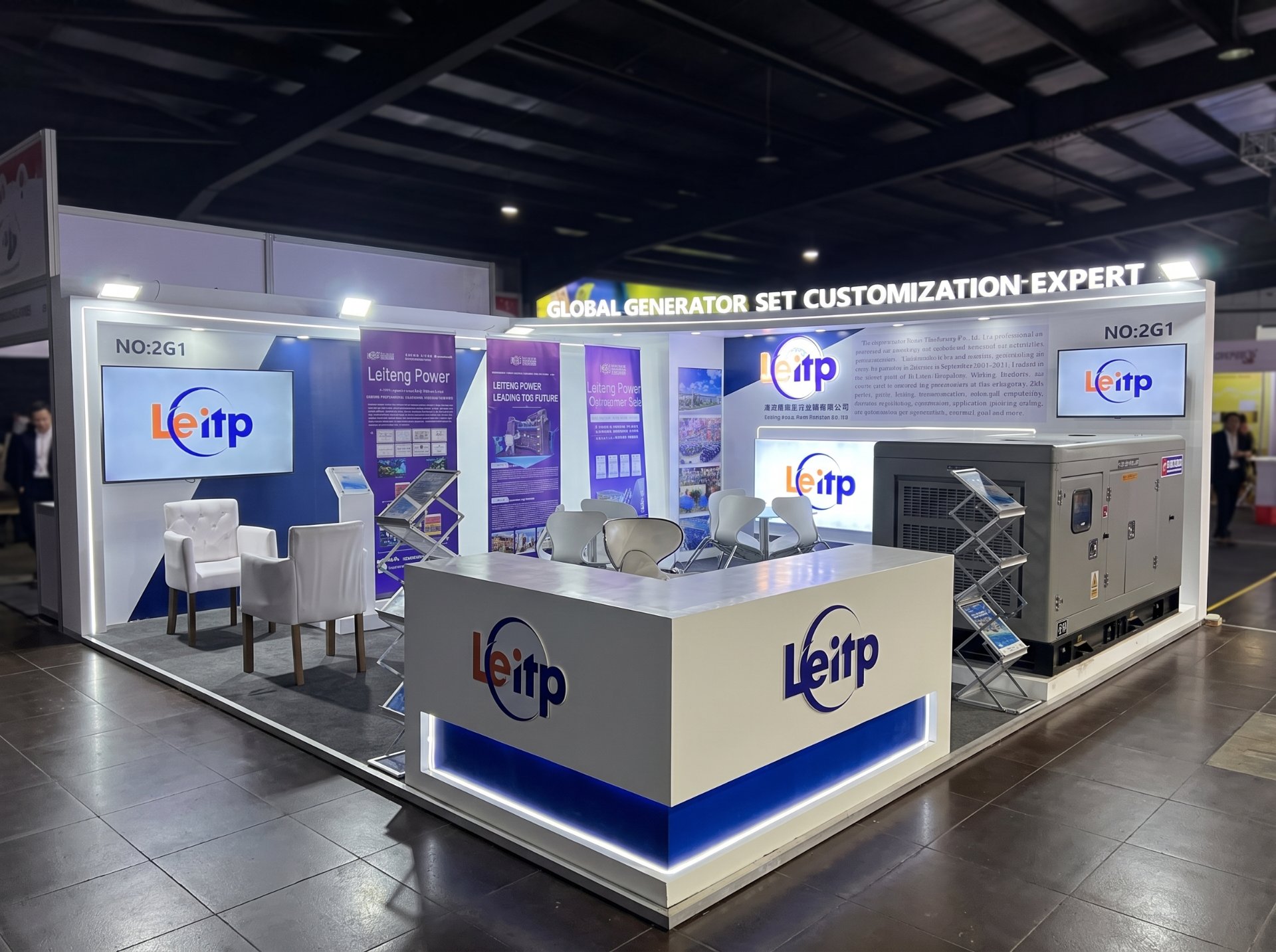
- Power redundancy. The national grid delivers an average of 4-6 hours of supply per day in Lagos and 8-10 hours in Abuja. We spec every Nigeria exhibition booth builder build with a 15-30 kVA diesel generator backup (or a hybrid inverter + lithium pack), automatic transfer switch, and surge protection for AV. The Leitp Global generator-set stand pictured above is itself a working example of this principle.
- SONCAP and NAFDAC compliance. Many product categories (electronics, cosmetics, food) require product certification before show-floor display. Working with a Nigeria exhibition booth builder that pre-clears SONCAP at the Standards Organisation of Nigeria and registers NAFDAC numbers on the booth graphic avoids 24-72 hour on-site customs holds.
- High-humidity and dust protection. Lagos humidity runs 75-90% for 9 months a year. We seal all electronics in IP54 enclosures and use marine-grade powder-coat on aluminium framing. Modular fabric graphics survive the salt air better than vinyl.
- Bilingual and on-the-ground staff. English is the business lingua franca, but Yoruba, Igbo, and Hausa buy-side conversations close deals. A Nigeria exhibition booth builder with a vetted local partner team holding ECOWAS trade credentials accelerates qualification calls.
Booth costs and timelines in Nigeria
Budgeting for a Nigeria exhibition booth builder build in 2026 depends on four variables: venue (ITFC and Abuja ICC charge higher stand-fitting fees than Eko), booth size (9 m² inline vs 80 m² island), power backup scope (a 30 kVA silent generator adds USD 3,500-5,500 for a 3-day show), and bonded-warehouse routing (Apapa vs Tin Can Island). Indicative price bands:
- Inline 9-12 m² modular booth — USD 5,000 to USD 10,000 design, build, ship, install, dismantle, with a 15 kVA generator.
- Corner 20-30 m² semi-custom booth — USD 12,000 to USD 25,000, with a 30 kVA silent generator and basic AV.
- Island 50-80 m² custom booth — USD 30,000 to USD 80,000+, with 60 kVA twin-generator backup, full AV suite, and bonded-warehouse pre-clearance.
Lead times from confirmation to on-site handover: 6-10 weeks for inline modular, 8-12 weeks for custom island. The Nigeria exhibition booth builder market runs hot in September-October (Lagos International Trade Fair) and March-April (Abuja Nigeria Oil & Gas). Lock your slot at least 3 months ahead of an ITFC or Eko show to avoid the December-January container congestion out of Shenzhen and Shanghai.
How NeoBooths delivers as your Nigeria exhibition booth builder
NeoBooths has shipped exhibition stands into Nigeria for over a decade. Our Nigeria exhibition booth builder workflow follows a fixed five-step path:
- Brief and 3D concept — 4-6 days. We work from your brand guidelines, event floor plan, and budget band. You receive a photoreal 3D render plus a transparent cost split that itemises the generator backup, SONCAP clearance, and bonded-warehouse line items before sign-off.
- Engineering and compliance check — 6-8 days. Our Shenzhen workshop issues structural drawings that satisfy ITFC and Abuja ICC on-site rules, plus SONCAP and NAFDAC product-display declarations.
- Production in Shenzhen — 3-4 weeks. CNC-cut panels, modular aluminium framing, fabric graphics, IP54-sealed AV integration, and a full pre-shipment QC check at our 12,000 m² facility.
- Sea freight to Lagos or Onne — 30-35 days door-to-door. We consolidate with our regular LCL service to Apapa or Tin Can Island, and pre-clear through our Nigerian bonded-warehouse partner to skip the 24-72 hour on-site customs hold.
- On-site install and dismantle — by a vetted Nigerian partner team holding ECOWAS trade credentials. They handle venue paperwork, generator refuelling, and post-show waste recycling per the venue's sustainability policy.
This same workflow is what we used for the Leitp Global generator-set customisation stand pictured above (Lagos International Trade Fair, booth NO.2G1) and for our recent Tudor Rossa watches booth at a South Africa exhibition. A Nigeria exhibition booth builder build from NeoBooths costs 20-30% less than a fully Lagos-sourced build at equivalent quality, because we shift labour-heavy fabrication to Shenzhen and keep only on-site assembly local.
Five pitfalls to avoid when you hire a Nigeria exhibition booth builder
- Skipping the generator backup. The national grid drops without notice, and a black booth on day one costs you every media moment. Build a 15-30 kVA generator into the line items, not as a contingency.
- Booking freight without a bonded warehouse. Apapa port congestion in Q4 adds 7-14 days. A Nigeria exhibition booth builder with a standing LCL slot and a bonded-warehouse partner pre-clears the container in days, not weeks.
- Ignoring SONCAP and NAFDAC rules. Product display without certification triggers on-site customs holds. Pre-clear through Standards Organisation of Nigeria and register NAFDAC numbers on the booth graphic.
- Underestimating humidity damage. Lagos salt air destroys vinyl graphics in 36 hours. Use marine-grade powder-coat and fabric graphics on every Nigeria exhibition booth builder build.
- Single-event-only design. If you exhibit at both a Lagos and an Abuja show in the same year, design a modular booth that craters into the same container twice. Saves 30%+ on round two.
Nigeria exhibition booth builder FAQ
How much does a Nigeria exhibition booth builder cost in 2026?
For a 9-12 m² inline modular booth, budget USD 5,000-10,000 design-to-dismantle, with a 15 kVA generator backup included. For a 50 m² island custom booth, USD 30,000-80,000+, including bonded-warehouse clearance and 60 kVA twin-generator backup. The cost depends on venue, customisation depth, and freight routing through Apapa or Tin Can Island.
Which is the best venue for a first-time exhibitor in Nigeria?
For a first-time Nigeria exhibition booth builder project, the Eko Convention Centre in Victoria Island is the most beginner-friendly: organised on-site logistics, English-first signage, and proximity to the Lekki deep-sea port for direct container drops. The Lagos International Trade Fair Complex (ITFC) in Ojo is the second-best, with the largest single-event foot traffic in West Africa.
Do I need SONCAP or NAFDAC certification to exhibit in Nigeria?
You do not need SONCAP or NAFDAC to exhibit as a foreign brand, but your Nigeria exhibition booth builder partner should pre-clear both on your behalf. SONCAP applies to electronics and industrial goods; NAFDAC applies to cosmetics, food, and health products. Without these, customs can hold the booth graphics and product samples at the port for 24-72 hours.
How long does shipping from China to Lagos take?
Sea freight from Shenzhen or Shanghai to Lagos (Apapa or Tin Can Island) takes 28-35 days. A Nigeria exhibition booth builder with a regular LCL consolidation slot and a bonded-warehouse partner can deliver to ITFC in 30-36 days door-to-door, including pre-clearance. Air freight cuts this to 4-6 days but triples the cost.
Can I re-use the same booth at multiple Nigerian shows?
Yes — and a good Nigeria exhibition booth builder will design the booth for multi-event re-use from day one. Modular aluminium framing, fabric graphics that swap without tools, and crate-on-wheels packaging cut the second-event cost by 30-40%.
Get your Nigeria exhibition booth builder quote in 24 hours
Send us your floor plan, brand guidelines, and target show date. A senior NeoBooths Nigeria exhibition booth builder lead will reply within 24 hours with a fixed-price quote, a 3D concept render, and a tentative production schedule that includes generator backup, SONCAP and NAFDAC clearance, and bonded-warehouse routing. We have shipped to Lagos, Abuja, Port Harcourt, and Kano every year since 2008.
Related guide: India exhibition booth builder: 2026 Mumbai & Delhi guide — part of the NeoBooths global exhibition market series.
Related guide: Mexico exhibition booth builder: 2026 exhibitor guide — part of the NeoBooths global exhibition market series.