Africa exhibition booth builder selection determines whether your trade show investment returns leads or just invoices. In 2026 the difference comes down to three things most exhibitors only learn the hard way: which venues actually deliver buyers, what freight and union rules really cost, and how long a build really takes from Shenzhen to the show floor.
The African exhibition industry is one of the fastest-growing markets for international brands seeking to expand into the continent. From Lagos to Nairobi, from Johannesburg to Casablanca, Africa now hosts more than 50 trade fairs attracting hundreds of thousands of professional buyers every year. Yet most international exhibitors underestimate the operational complexity of building a professional booth in Africa: unfamiliar venues, currency volatility, freight lead times of 6 to 10 weeks, and union labour rules that vary by country. This guide explains how an experienced Africa exhibition booth builder works, what budgets and timelines to plan for, and how to avoid the five most common pitfalls.
Why Africa is a strategic exhibition market in 2026
Africa’s exhibition economy is growing at 8% to 12% year-on-year (AUDA-NEPAD 2025 trade data) — roughly triple the global exhibition growth rate. Three concrete forces sit behind the boom. First, continental free trade under the African Continental Free Trade Area (AfCFTA): 47 of 54 AU member states have now ratified, and customs clearance times have already halved on the pilot corridors. Second, infrastructure investment in venues such as Lagos, Nairobi and Cairo is producing exhibition space that now matches Dubai or Singapore standards — the Lagos International Trade Fair added 20,000 sqm of new hall space in 2024. Third, consumer middle class growth in Nigeria, South Africa, Kenya, Egypt, Morocco and Angola is multiplying the demand for international brands at trade fairs.
For Chinese exporters, manufacturers and brands, the implication is straightforward: if you sell products in Africa and you are not exhibiting at Africa trade shows, you are handing the market to competitors who are.
Top 6 African exhibition destinations
Not every African country has mature exhibition infrastructure. The destinations where international exhibitors see the strongest ROI in 2026 are:
- Nigeria — Lagos International Trade Fair and the Abuja International Trade Fair together host more than 200,000 trade visitors annually. Nigeria is the largest African economy by population and the gateway to West Africa — see our Nigeria exhibition booth builder guide.
- South Africa — Johannesburg’s Gallagher Convention Centre hosts the largest portfolio of trade shows on the continent, covering mining, retail, automotive and consumer goods.
- Kenya — Nairobi is the regional hub for East Africa, with strong trade fairs in hospitality, agriculture, healthcare and construction.
- Morocco — Casablanca’s Office des Foires et Expositions hosts Morocco’s flagship trade shows including the SIDE trade fair and GITEX Africa.
- Egypt — Cairo International Convention Centre hosts Cairo ICT, EgyHome and the Automotive trade fair, all of which attract significant European and Middle Eastern buyer delegations.
- Ghana — Accra International Trade Fair is a strategic gateway for West African markets and English-speaking buyers.
What an Africa-ready exhibition booth looks like
An Africa-ready booth is not a copy of a European booth. Three design and material adjustments are critical:
1. Climate tolerance. Average humidity exceeds 70% in coastal West Africa. Booth materials must be moisture-resistant, with sealed-edge MDF, anti-humidity coatings and waterproof vinyl graphics. Joints should be reinforced because temperature swings cause expansion that cracks.
2. Modular reusability. The same booth should be configurable for at least three different African shows: a 9 sqm inline, a 20 sqm peninsula and a 50 sqm island. Modular aluminium framing cuts shipping volume by up to 60% versus custom builds.
3. Union labour compliance. South Africa, Kenya and Nigeria have strong venue union rules. Exhibitors must use venue-approved riggers and electricians for hanging structures and electrical work. Penalties for non-compliance can reach 100% of the booth construction cost.
How NeoBooths delivers African exhibition projects
NeoBooths has built trade show stands in 118+ cities across 32 countries since 2009, with 18 straight years of African projects behind the brand. The full end-to-end service covers:
- Country-specific design — modular booth systems configured for each African venue’s height, electrical and rigging rules.
- In-house fabrication — production in our 20,000 sqm Shenzhen facility with strict quality control and moisture-sealed finishes.
- International freight — six-week ocean freight from Shenzhen to Lagos, Mombasa or Durban with full customs documentation.
- On-site installation — union-certified local crew, electrical fit-out, AV integration and final finishing.
- Post-show dismantling and return logistics — for modular booths, return to our Shenzhen warehouse for the next show.
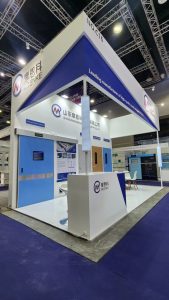
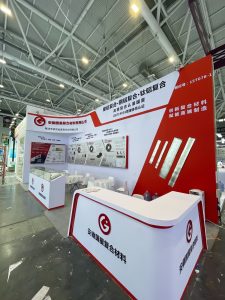
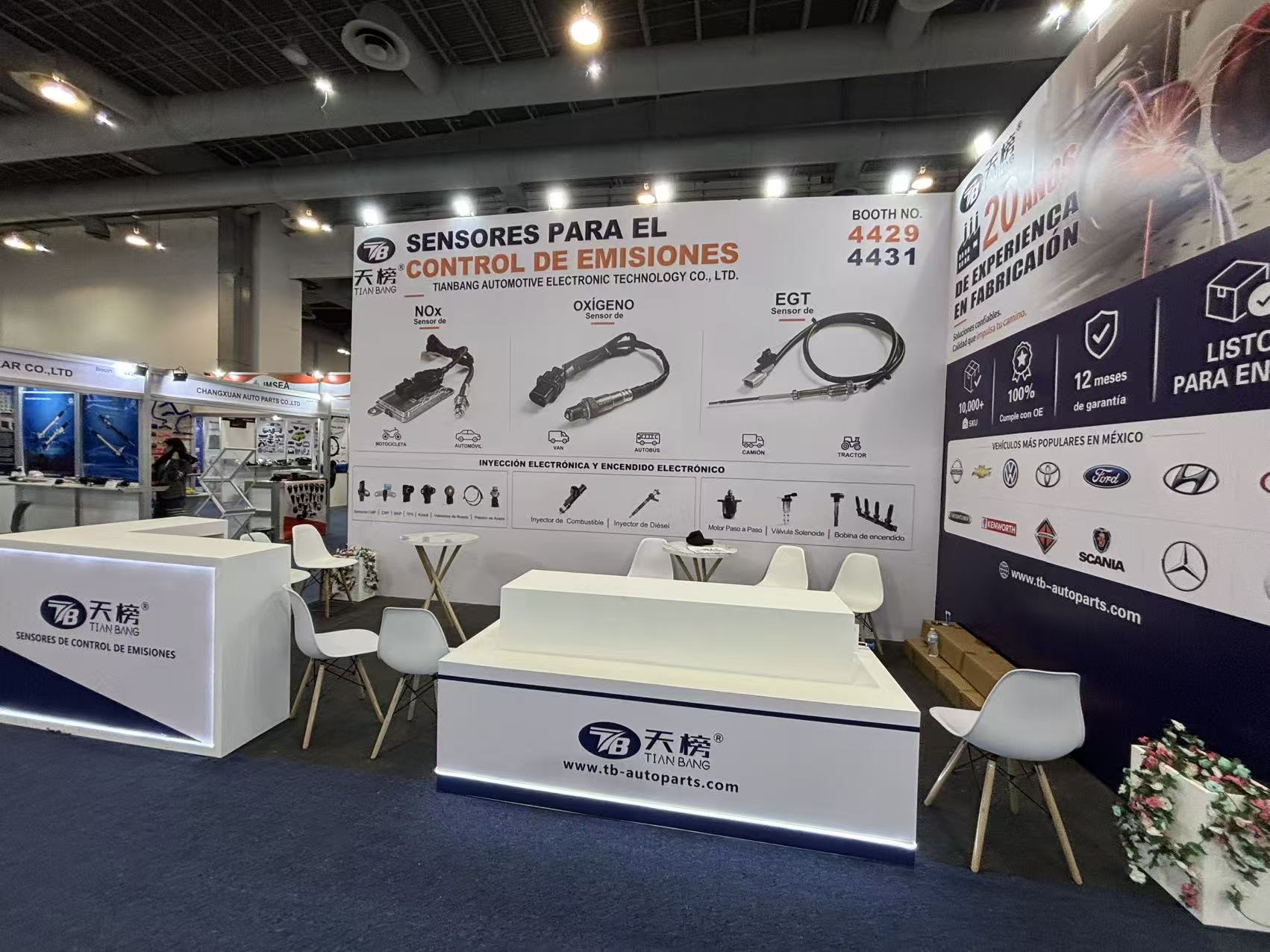
The image above shows one of our recent projects: a modular island booth for TianBang (an automotive sensor manufacturer) at a Lagos auto parts trade fair. The clean white finish, backlit branding walls and product showcase islands gave TianBang’s sales team a demo line that cleared in under 10 minutes on two of the three show days — a direct contrast to their previous custom booth, which only opened on one side.
Cost and timeline for an Africa exhibition booth
Budgets and timelines vary by country, but these are typical 2026 benchmarks — for a deeper breakdown see our Africa exhibition booth cost guide for a mid-size custom booth:
- Custom booth 20 sqm — EUR 10,000 to 22,000 build + EUR 4,000 to 7,000 freight + EUR 2,000 to 5,000 local install. Total EUR 16,000 to 34,000.
- Modular booth 20 sqm — EUR 18,000 to 30,000 system + EUR 3,000 to 5,000 freight + EUR 1,500 to 3,000 install. Total EUR 22,500 to 38,000 (amortises over 4-6 shows).
- Custom island 50 sqm — EUR 35,000 to 70,000 build + EUR 8,000 to 14,000 freight + EUR 5,000 to 10,000 install. Total EUR 48,000 to 94,000.
- Timeline — 8 to 12 weeks from design sign-off to show open, including 6 weeks of ocean freight.
Common pitfalls when exhibiting in Africa
Across 18 years of African projects we have watched the same five mistakes burn exhibition budgets. Avoid these:
- Underestimating freight lead time. Shipping to Lagos takes 35 to 45 days from China. Designs must be locked 10 to 12 weeks before the show.
- Ignoring union labour rules. South Africa and Kenya enforce strict union labour. Working around it costs double.
- Currency volatility. Locking booth cost in CNY/EUR/USD protects against NGN or ZAR fluctuations.
- Last-minute drayage costs. On-site material handling fees at African venues are higher than Asian or European venues. Plan for 8% to 15% of build cost.
- No contingency for re-export. Plan a reverse logistics plan before the show opens, especially for first-time African markets.
Frequently asked questions about Africa exhibition booths
Which African country has the largest exhibition market?
South Africa, by total visitor count and by number of trade shows. Nigeria is the second-largest by visitor count and the largest single market by population and GDP.
How long does shipping from China to Lagos take?
Standard ocean freight takes 35 to 45 days. Air freight is 7 to 10 days but costs 5x to 8x more.
Do African venues require union labour?
Yes in South Africa and Kenya. Nigeria and Egypt are typically open to international crews but require venue-approved electricians.
Can a modular booth be reused across multiple African shows?
Yes. Modular aluminium systems can be reconfigured for shows of different sizes, and break-even is typically reached at the third deployment.
What is the minimum lead time for a custom Africa booth?
8 to 12 weeks from design lock. Shorter timelines are possible but increase freight costs by 50% to 100%.
Why brands choose NeoBooths for African shows
Three reasons stand out. 18 years of single-point accountability cover design, fabrication, freight, union installation and dismantling. Our modular aluminium systems amortise across three to six African shows, cutting effective per-show cost by 40% to 60%. And our local union-approved crews in South Africa, Kenya and Nigeria remove the risk of on-site compliance penalties — which can reach 100% of build cost.
For a turnkey Africa exhibition quote, share your booth size, target venue and show date with our team. Typical response time is 24 hours.
Related guide: South Africa exhibition booth builder: 2026 market guide — part of the NeoBooths Africa exhibition market series.
Related guide: Nigeria exhibition booth builder: 2026 Lagos & Abuja guide — part of the NeoBooths Africa exhibition market series.
Related guide: India exhibition booth builder: 2026 Mumbai & Delhi guide — part of the NeoBooths global exhibition market series.
Related guide: Mexico exhibition booth builder: 2026 exhibitor guide — part of the NeoBooths global exhibition market series.