An oil and gas trade show booth carries a heavier job than most exhibition stands. The buyers are national oil companies, operators and engineering contractors, the contracts run into millions of dollars, and the audience includes ministers as often as procurement managers. That reality is on full display this month: the 31st Oil & Gas of Turkmenistan (OGT 2026) closed in Ashgabat on 23 October, and ADIPEC 2026 opens in Abu Dhabi on 2 November. If your company is preparing for either end of that calendar, here is how to plan a stand that earns its budget.
Why Oil and Gas Exhibitions Play by Different Rules
Energy exhibitions are not general trade shows with bigger machinery. They are structured around national delegations, state-owned operators and multi-year project pipelines, so a badge scan matters less than the handful of pre-arranged meetings with the right technical buyer. At ADIPEC, the organiser reports that 95% of attendees are involved in purchasing decisions, which means almost everyone walking the floor can sign or influence a contract.
Three features shape booth strategy in this sector:
- Country pavilions dominate the map. National oil companies and export agencies book large blocks, and independent exhibitors often sit inside a pavilion with fixed shell-scheme rules.
- Security and protocol matter. Ministerial openings and VIP tours mean stands near the main aisles may host unannounced visits, so the booth must look presentation-ready from the opening bell.
- Products are heavy and technical. Meters, valves, pipeline components and sensors need display systems that carry real weight and support hands-on demonstrations.
The Oil and Gas Exhibitions That Matter in 2026 and 2027
The energy exhibition calendar concentrates into a handful of anchor events, and picking the wrong one wastes a full sales season. Match the show to your product line first; adjacent sectors follow the same logic, as our energy storage trade show booth guide shows for the battery and storage circuit.
OGT 2026: The Gateway to Central Asia
OGT, the International Conference & Expo "Oil & Gas of Turkmenistan", ran its 31st edition on 21–23 October 2026 at the Chamber of Commerce exhibition hall in Ashgabat under the motto "Energy. Cooperation. Development." The programme tracked on ogt-turkmenistan.com focused on energy security, digitalisation, methane emissions reduction and gas chemistry, alongside investment topics such as the Galkynysh field and Caspian projects. In the run-up, organisers confirmed more than 100 international delegates from over 20 countries, with SOCAR returning as Premier Partner. For suppliers of metering equipment, valves, pumps and field technology, OGT is the rare event where Central Asian buyers come to you.
ADIPEC 2026: The Region’s Anchor Event
ADIPEC 2026 runs 2–5 November 2026 in Abu Dhabi and is billed by its organiser as the world’s largest energy exhibition and conference, with 239,000+ attendees, 2,250+ exhibitors, 30 country pavilions and 54 NOCs, IOCs, NECs and IECs taking part. Specialised zones — the AI Zone curated with ADNOC, Low Carbon & Chemicals, Maritime & Logistics and Digitalisation — now segment the floor, so choose booth location by product story and neighbor relevance, not just raw foot traffic.
Houston 2027: OTC and Gastech in One City
Houston concentrates two of the biggest energy shows of 2027. Current event calendars list the Offshore Technology Conference (OTC) at NRG Park on 3–5 May 2027, and Gastech at the George R. Brown Convention Center on 14–17 September 2027, where recent editions drew around 60,000 attendees from 150 countries per the organiser. Exhibiting in the United States adds its own labor and paperwork rules, which is exactly where an experienced local crew pays for itself.
Designing a Booth That Wins Energy Buyers
Energy buyers respond to substance. A stand that presents the product range clearly, allows a hands-on demonstration and offers a quiet corner for negotiation will outperform a purely decorative build every time. In practice that means:
- A structured display wall. Group products by family — ultrasonic meters, control valves, communications units — and label them in the buyer’s language. At OGT, Russian-language graphics are standard; in Abu Dhabi, English with Arabic headlines works best.
- Demo counters with live samples. Instruments invite touch. Leave counter depth for working units and brochures, and keep spare stock out of sight in dedicated storage.
- A real meeting space. Long procurement conversations need seating, a table and enough privacy to discuss pricing. Even a 12–24 sqm inline stand can carve out a two-seat meeting corner.
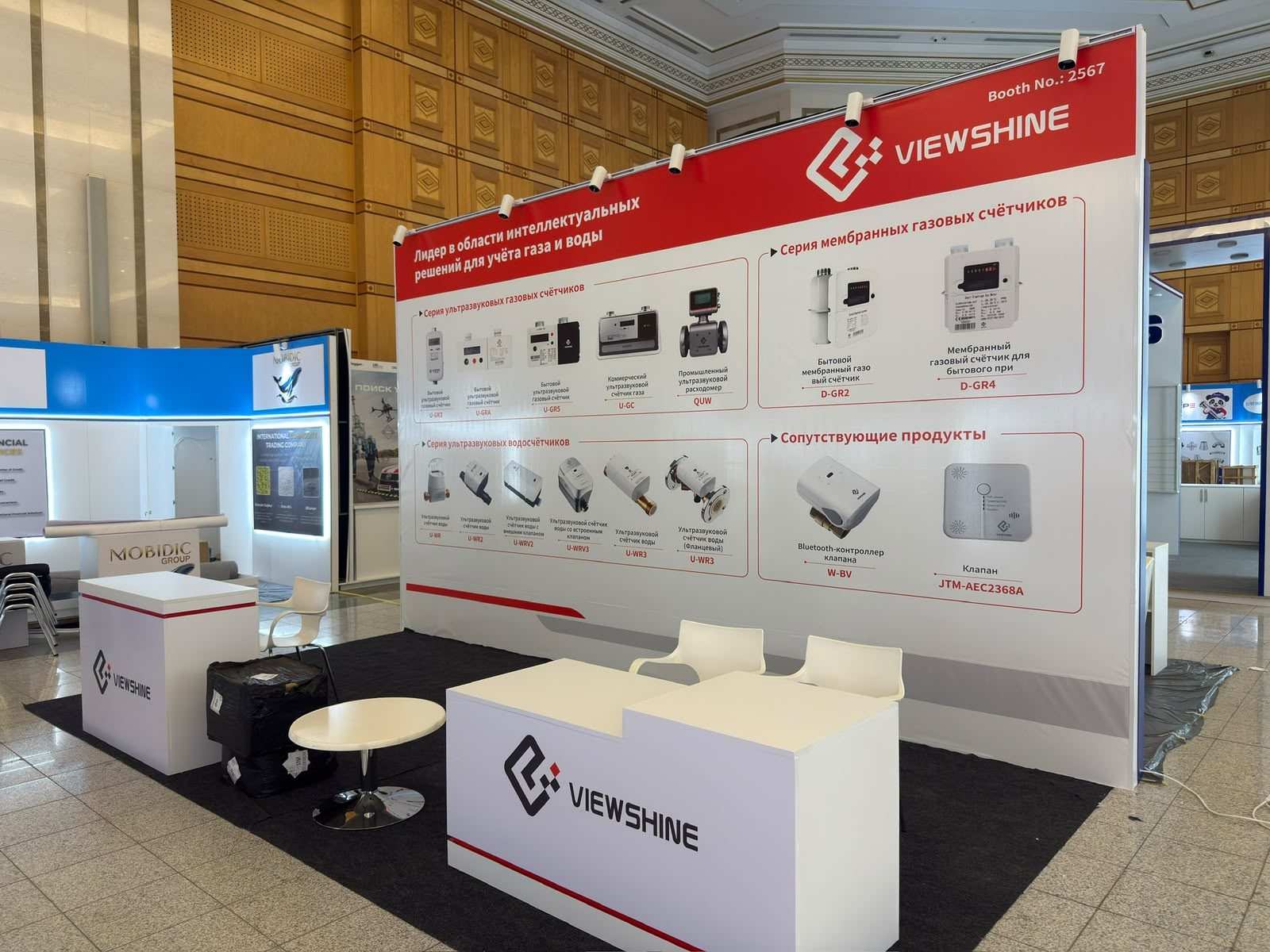
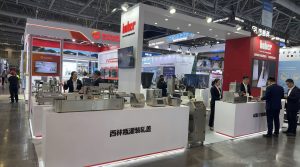
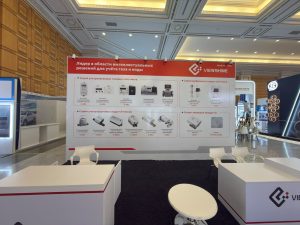
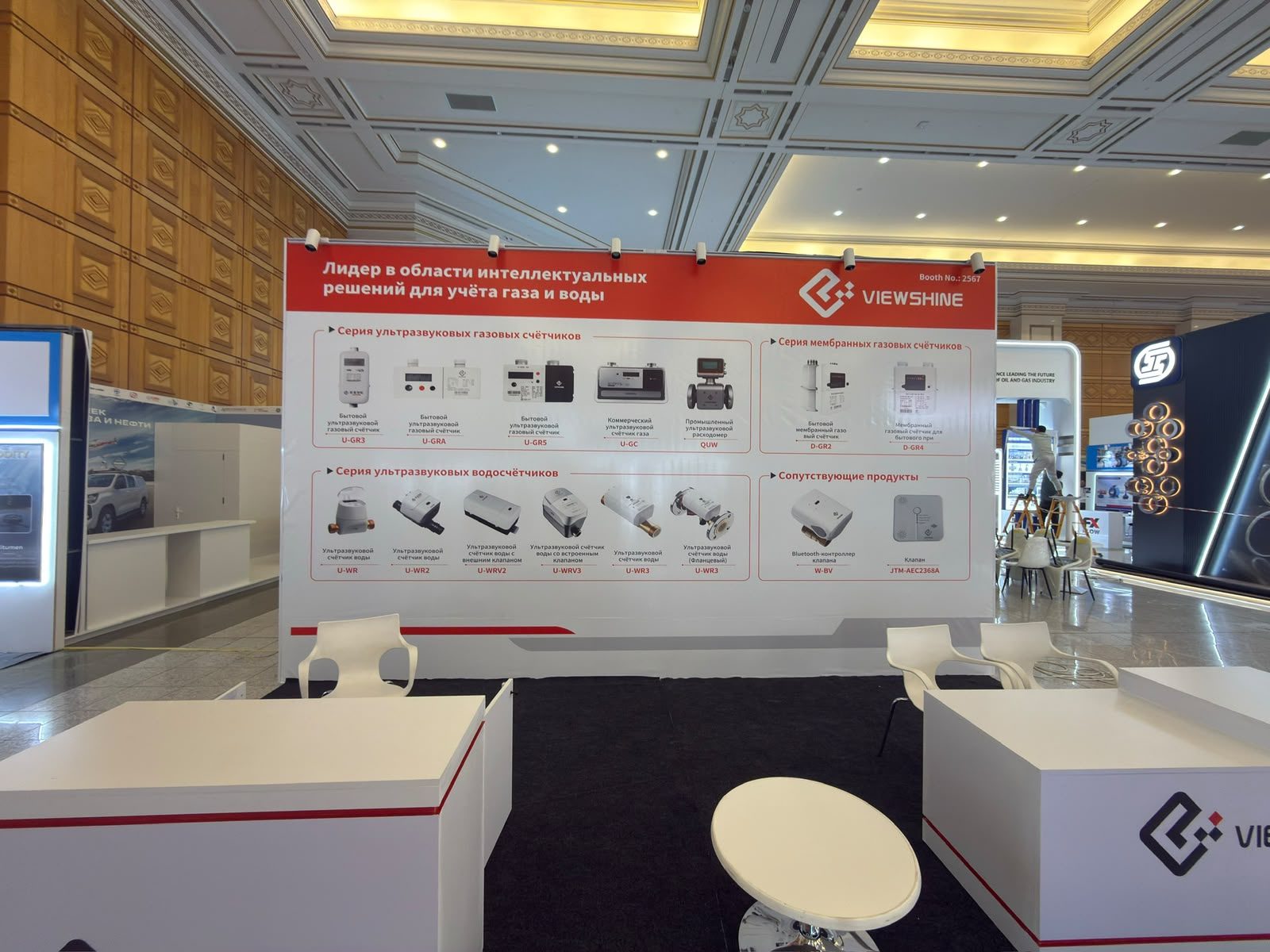
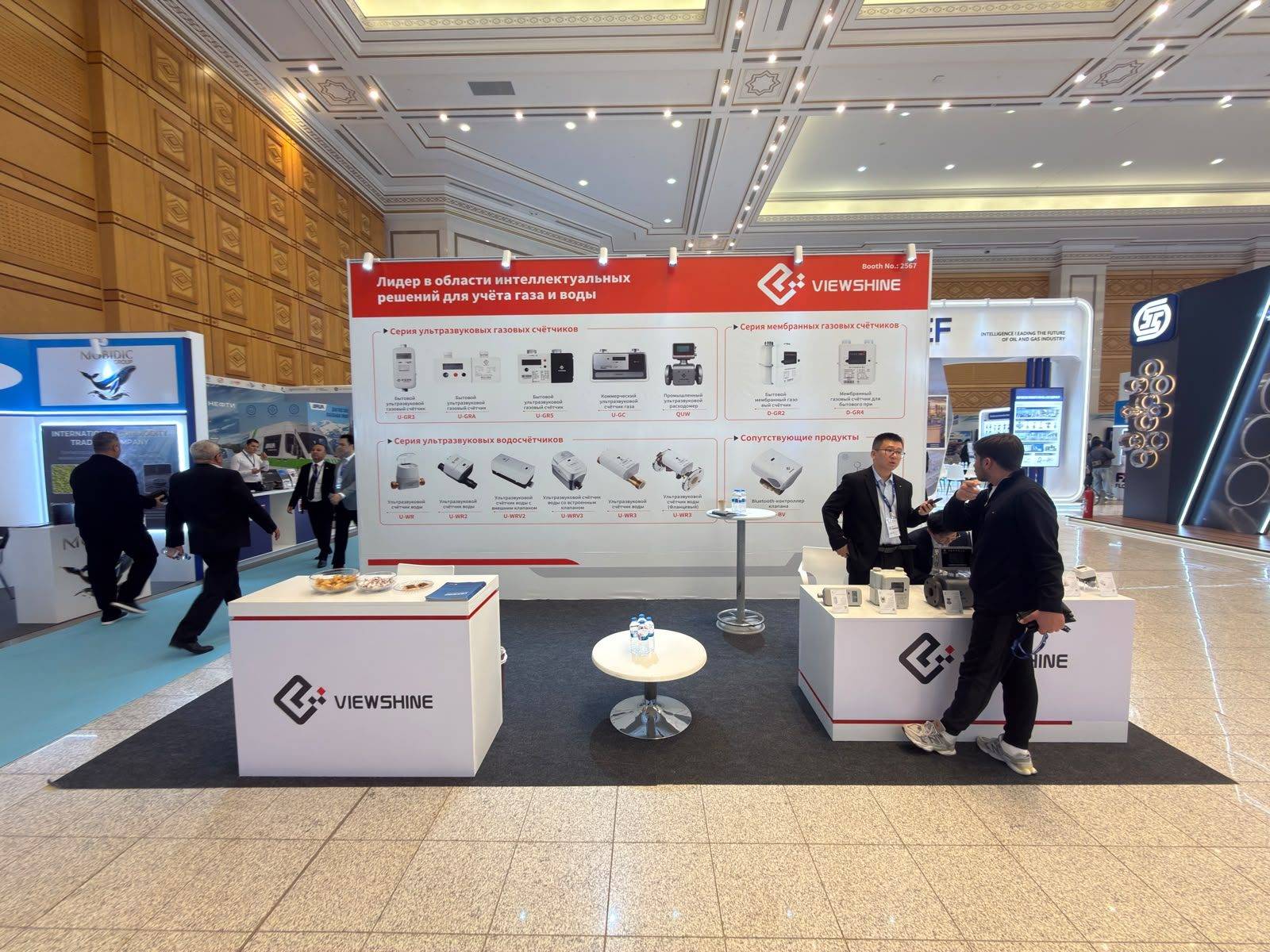
New Power Exhibition (NeoBooths) designed, fabricated and installed a custom stand at OGT 2026 in Ashgabat, where a metering technology client needed exactly this mix: a red-and-white product wall with Russian-language graphics, two reception counters and a compact meeting zone, all built and handed over before the ministerial opening. The same checklist scales up to a 100 sqm island at ADIPEC or a two-storey stand in Houston.
Venue Rules, Crew Visas and Shipping Lead Times
Turkmenistan has the strictest entry process on the circuit. Exhibitors and installation crew need a letter of invitation (LOI), which the State Migration Service typically issues in 7–10 working days; after that you either collect a visa at a Turkmen embassy in 3–5 working days or present the hard-copy LOI on arrival. Build that timeline into the project plan, because a crew that cannot land cannot build.
Freight is the second constraint. Central Asian venues offer limited on-site storage and narrow handling windows, so cases should ship early and clear customs with the organiser’s agent. In Abu Dhabi and Houston the constraints differ: ADNEC and the Houston venues run tight move-in schedules, US halls often require certified union crews for rigging and material handling, and drawing approvals for anything overhead are due weeks before doors open. A builder who works the region year-round absorbs these rules for you; a first-time exhibitor should ask about every one of them before signing the contract.
Budgeting and Timeline for Your Oil and Gas Booth
Use the 2.5x rule as a starting frame: whatever you pay for floor space, budget roughly two and a half times that amount for design, build, graphics, logistics and on-site services. Space at flagship energy shows commands a premium, and a shell-scheme country pavilion stand keeps costs predictable but locks you into fixed walls. On our published benchmarks, a custom 100 sqm build sits around €35,000 in Europe and roughly €55,000 in the United States, while Central Asian fabrication costs less locally — with freight and visa logistics adding part of the saving back.
Timeline matters as much as money. A design-build cycle of 4–8 weeks covers most single-storey stands, but Ashgabat projects should add visa and freight buffers and start 10–12 weeks out at minimum; for ADIPEC, OTC or Gastech, six months is the comfortable mark. If you want a costed proposal against a specific floor plan, see how our design-and-build service works or contact our team with your dates and target shows.
Frequently Asked Questions
How far in advance should we book a stand builder for ADIPEC?
Ideally six months before the show. ADIPEC runs 2–5 November 2026, so the window for this edition is already short: commit a builder now, lock the design within two weeks, and reserve fabrication and freight slots immediately. A typical design-build cycle runs 4–8 weeks before rigging and installation deadlines.
Can our own team install the booth in Turkmenistan?
Yes, with organiser approval — but every crew member needs the LOI-based visa, and the LOI alone takes 7–10 working days before embassy processing or arrival with the hard-copy letter. Many exhibitors let their stand builder coordinate local partners and site supervision instead of flying a full crew.
What booth size does an oil and gas exhibitor need?
First-time pavilion exhibitors usually take 12–36 sqm, which fits a display wall, a demo counter and a meeting corner. Companies demonstrating skid-mounted or large equipment typically need 54–100+ sqm, and any two-storey stand at ADIPEC requires venue structural approval booked well ahead.
How do we measure ROI from an energy exhibition?
Track cost per qualified meeting rather than raw scans. Because most visitors hold purchasing responsibility — ADIPEC’s organiser puts the share at 95% — the stand’s job is to convert pre-booked meetings and structured demos into next-step commitments, with follow-up dispatched within 48 hours of the show closing.