I keep hearing the same quiet panic from marketing teams before a show:
“What if we spend all this money… and no one stops?”What if the booth looks great — but doesn’t convert?”What if the traffic comes… but the leads don’t?”
Fair questions. Because if you’ve walked any major expo floor lately, you’ve seen it: rows of expensive booths doing… very little.
Not because brands don’t care. But because trade show booth design is often treated like a visual project, not a
commercial one.
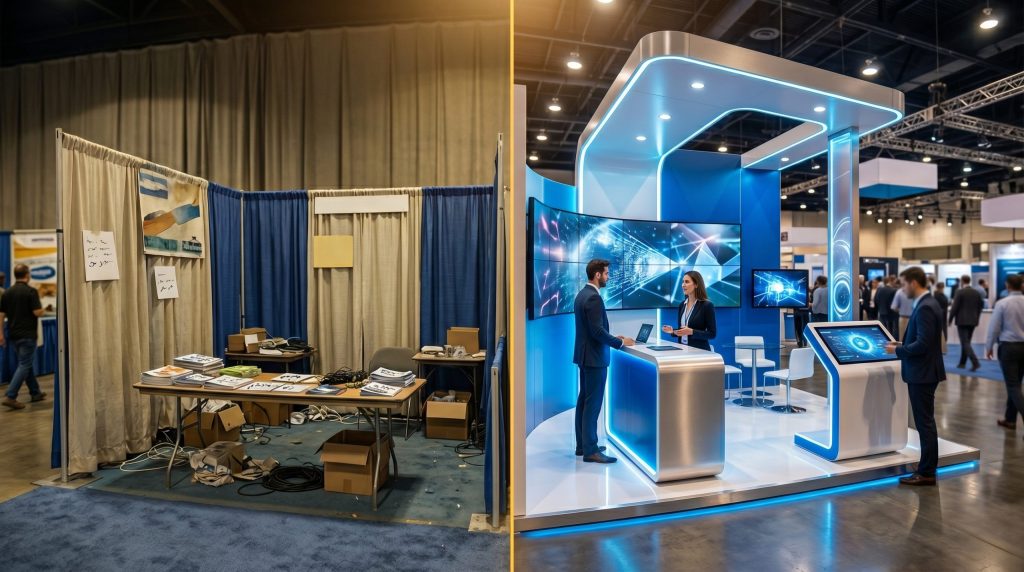
The Real Problem: Good-Looking Booths That Don’t Work
Most teams hire trade show booth design companies to “make something eye-catching.” And they usually get exactly that.
Nice lighting. Clean branding. Big screens.
But here’s what’s missing:
- No clear entry point → people hesitate at the edge
- No reason to stay → traffic flows past, not through
- No interaction → no conversation → no conversion
I’ve seen booths with six-figure budgets get outperformed by smaller stands simply because one had a flow, and the other didn’t.
Design isn’t the problem. Design without intent is
What High-Performing Booths Actually Do Differently
After covering enough shows — from CES-style chaos to niche B2B expos — a pattern shows up.
The booths that win don’t just “look better.” They behave differently.
- They Control Movement (Not Just Attention)
Strong trade show booth design services think in terms of movement, not decoration.
Where do people stop?
Where do they turn?
Where does the first conversation happen?
If your booth doesn’t guide traffic, it leaks it.
Some designers now borrow from retail layout logic — decompression zones, focal points, dwell areas. It’s not new. It’s just rarely applied properly in exhibitions.
- They Give People a Reason to Engage
A booth without interaction is basically a billboard.
And people don’t attend trade shows to look at billboards.
The better trade show booth design company teams build in:
- Quick demos (30–90 seconds)
- Hands-on elements
- Visual “moments” worth photographing
Not gimmicks — just enough friction to slow someone down.
Because once someone stops, you’ve already won half the battle.
- They Align Design With Sales Outcomes
This is where most projects quietly fail.
Marketing signs off on the visuals.
Sales shows up later and tries to make it work.
The result? A disconnect.
Some trade show booth design companies now start with questions like:
- What qualifies as a good lead at this show?
- How many conversations do you need per day?
- What’s the expected ROI per square metre?
That changes everything — layout, messaging, staffing zones, even storage placement.
The Cost Question Nobody Likes to Ask
Here’s the uncomfortable part.
You can spend £50,000 on a booth and get nothing.
You can spend £20,000 and walk away with a pipeline.
The difference usually isn’t budget — it’s structure.
I’ve spoken to teams who assumed hiring premium trade show booth design services guaranteed results. It didn’t because execution wasn’t tied to outcomes.
Others went modular, simpler — but strategic — and saw better lead quality.
So the question isn’t: “How much should we spend?” It’s: “What is this booth supposed to produce?”
A Practical Way to Think About Booth Design
If you’re planning your next event, this framework tends to hold up:
Start with outcomes
Leads? Demos? Brand exposure? Pick one primary goal.
Map the visitor journey
From aisle → entry → engagement → exit.
Design for behaviour, not aesthetics
What do you want people to do, not just see?
Pressure-test your layout
If 10 people enter at once, does it still work?
Choose the right partner
Not all trade show booth design companies think commercially. Some just build.
Where Most Teams Still Get It Wrong
A few recurring patterns:
- Over-designing for executives, not attendees
- Ignoring the staff workflow inside the booth
- Treating post-show follow-up as an afterthought
- Choosing a trade show booth design company based on visuals alone
None of these is fatal individually. Together, they usually are.
Final Thought
Trade shows are one of the few places where marketing and sales happen in the same square metre, at the same time.
That’s rare.
Done right, a booth isn’t a cost centre — it’s a live conversion environment.
Done wrong, it’s just expensive furniture.
And maybe that’s the real divide between average booths and high-performing ones: one is designed to be seen — the other is designed to work.
References
- Centre for Exhibition Industry Research (CEIR) — Exhibition performance benchmarks
- Event Marketing Institute — Attendee engagement studies