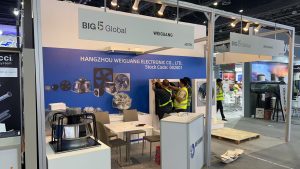
Why do so many 10×10 booths fail?
You’ve probably seen it.
Same hall. Same budget range. One trade show booth is packed all day. The one next to it? Staff checking phones, scanning badges out of boredom.
So what actually went wrong?
Most teams assume it’s budget. Or location. Or “we just needed a bigger stand.”
But if you’ve walked enough floors like I have, you start noticing a pattern.
It’s rarely size. It’s almost always decisions.
Especially with a 10×10 trade show booth, every mistake gets amplified. There’s nowhere to hide bad design, weak messaging, or a rushed trade show booth rental.
And yet, some brands still make it work. Really well.
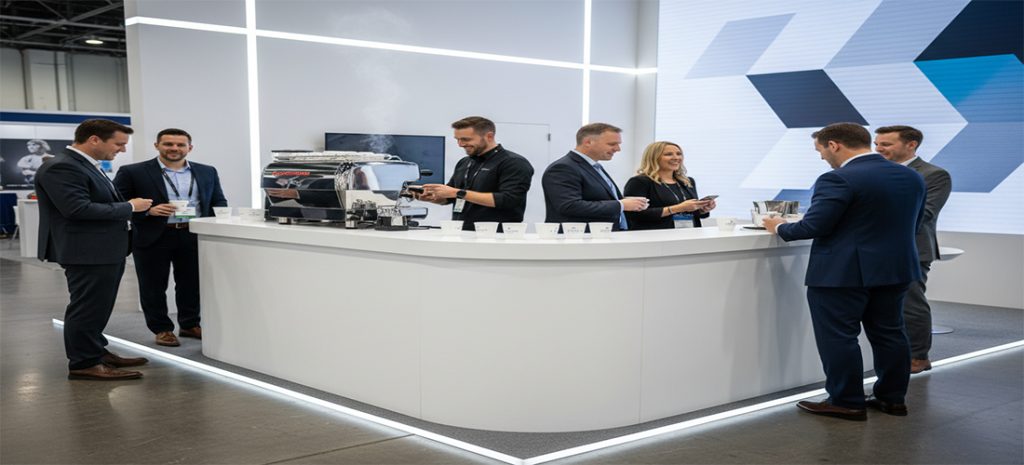
The real constraint isn’t space. It’s clarity.
A 10×10 footprint forces focus. No excess. No filler.
Some exhibitors treat that as a limitation. Others use it as leverage.
The best trade show booth ideas I’ve seen in small spaces all share one thing:
They decide what matters early and cut everything else.
Not “add more screens.”
Not “make it louder.”
Just clearer.
10 ideas that actually work in a 10×10 trade show booth
These aren’t theoretical. These are patterns that show up again and again across industries.
1. One message. Not five.
If someone can’t understand what you do in three seconds, they won’t ask.
Many trade show booth 10×10 setups try to say everything. That’s usually a mistake.
2. Design for stopping power, not decoration
Bold contrast beats pretty gradients.
People don’t slow down for “nice.” They stop for clear.
3. Use height strategically
Even in a 10×10 trade show booth, vertical space is underused.
A well-placed header can pull attention from across the aisle.
4. Ditch the table barrier
Tables often create distance. Some teams remove them entirely.
It changes how people walk in and engage.
5. Make interaction unavoidable
A demo, a quick test, a physical product. Something tactile.
Passive booths get passive results.
6. Staff behaviour matters more than layout
This one’s uncomfortable.
You can have great trade show booth ideas, but if your team stands in a circle talking to each other, it’s over.
7. Lighting is a multiplier
Not expensive. Just intentional.
Focused lighting can make a small trade show booth feel premium.
8. Give people a reason to stay
Not just freebies.
Maybe it’s a quick insight, a tool, or even just a useful conversation.
9. Reduce visual noise
Less text. Fewer colours.
Clarity usually outperforms creativity in tight spaces.
10. Build for flow, not symmetry
Some layouts look balanced but block movement.
The better booths guide people in without friction.
Where most trade show booth rental decisions go wrong
This is where things get expensive.
A trade show booth rental is often chosen based on convenience or catalogue appeal.
“Looks good, fits the budget, done.”
But maybe that’s the wrong lens.
From what I’ve seen, poor rental decisions usually fall into a few patterns:
- Overdesigned structures that eat up usable space
- Generic layouts that don’t match the brand’s actual goal
- Poor material quality that signals “temporary”
- Hidden costs that show up late in the process
Some teams end up spending more fixing a bad rental than they would have designing it properly from the start.
So what should you actually do differently?
If you’re planning your next 10×10 trade show booth, a few shifts seem to matter:
- Start with the goal, not the design
- Choose a trade show booth rental that supports behaviour, not just aesthetics
- Test your message out loud before committing it to graphics
- Watch how people move through similar booths at this show
- Adjust quickly, even during the event if needed
None of this is complicated. But it does require intention.
A small booth can outperform a big one
This might sound counterintuitive, but smaller booths often win when they’re focused.
Less space forces better decisions.
Better decisions create better outcomes.
And if you get it right, a trade show booth 10×10 doesn’t feel small at all. It feels efficient.
References
- Centre for Exhibition Industry Research (CEIR) – Exhibition performance insights
- Event Marketer – Experiential marketing benchmarks
- Harvard Business Review – Decision-making under constraints
- UFI (Global Association of the Exhibition Industry) – Trade show trends and data