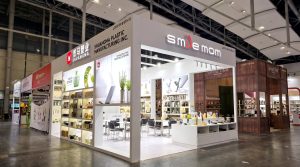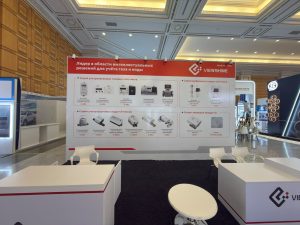
Hong Kong packs some of Asia’s highest-value sourcing events into two compact venues, and a well-planned Hong Kong trade show booth can put your brand in front of buyers from more than a hundred countries in a single week. The city’s fairs run tight, dense schedules — halls are busy, aisles move fast, and buying teams arrive with shortlists already written. That combination rewards exhibitors who treat their stand as a precision tool rather than a decorated space. This guide walks through the decisions that matter most when exhibiting in Hong Kong: which venue you are at, how to design for compact halls, the compliance rules that catch first-timers out, and what a realistic budget looks like.
Why Exhibit at a Hong Kong Trade Show
Hong Kong’s role as a sourcing gateway is the core reason international exhibitors keep returning. The Trade Development Council (HKTDC) runs a dense calendar of category-defining fairs, and the current season shows the rhythm well: the Hong Kong Electronics Fair (Autumn Edition) and electronicAsia ran 13–16 October 2026 at the Hong Kong Convention and Exhibition Centre (HKCEC), followed by the Autumn Lighting Fair on 27–30 October 2026. Looking ahead, the published HKTDC calendar lists the Hong Kong Toys Fair on 11–14 January 2027, the Diamond, Gem & Pearl Show at AsiaWorld-Expo on 2–6 March 2027, the Hong Kong International Jewellery Show on 4–8 March 2027, FILMART on 15–18 March 2027, the Spring Electronics Fair and InnoEX on 13–16 April 2027, and the Gifts & Premium Fair on 27–30 April 2027.
Three structural advantages repeat across every one of these shows. First, buyer quality: HKTDC fairs are built around sourcing missions, so visitors arrive as professional buyers rather than the general public. Second, timing: Hong Kong fairs sit deliberately close to Guangzhou’s Canton Fair windows and mainland production hubs, which lets buying teams combine trips. Third, scale per square metre: because venues are compact, a well-positioned 18–36 sqm stand works harder here than the same footprint at a sprawling European fairgrounds. You can check exact dates for any given week on the official HKCEC event calendar before committing to space.
HKCEC or AsiaWorld-Expo: Know Your Venue
Hong Kong’s trade fairs split across two very different venues, and your booth plan should follow the hall. The Hong Kong Convention and Exhibition Centre sits on the Wan Chai waterfront, attached to hotels and the MTR, in the middle of the business district. Its halls are multi-level and column-dense compared with newer venues, hall ceilings are lower than you may be used to, and rigging points are strictly controlled. Buyers walk in and out of HKCEC all day — lunch meetings happen at nearby hotels, which makes a booth with a proper meeting area genuinely useful.
AsiaWorld-Expo (AWE), next to Hong Kong International Airport on Lantau Island, is the opposite profile: a single-level hall complex with higher clear heights and direct airport adjacency, which is why heavy-machinery, aviation, and logistics events favour it, and why the Diamond, Gem & Pearl Show runs there each March before the jewellery week moves to HKCEC. For exhibitors, the practical differences come down to three things: ceiling height and rigging options, freight access (AWE wins — trucks reach the halls directly), and buyer dwell time (HKCEC’s downtown position extends conversations beyond show hours). Confirm which hall your space sits in before finalising a design that relies on height or suspended elements.
Booth Design for Hong Kong’s Compact, High-Value Halls
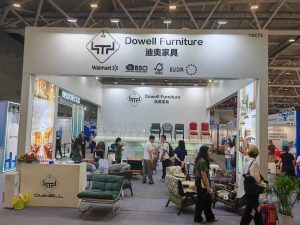
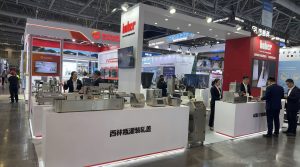
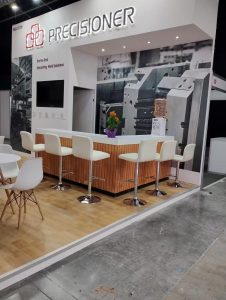
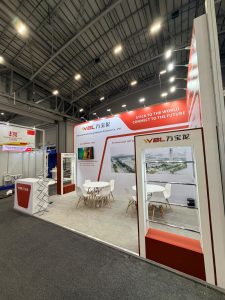
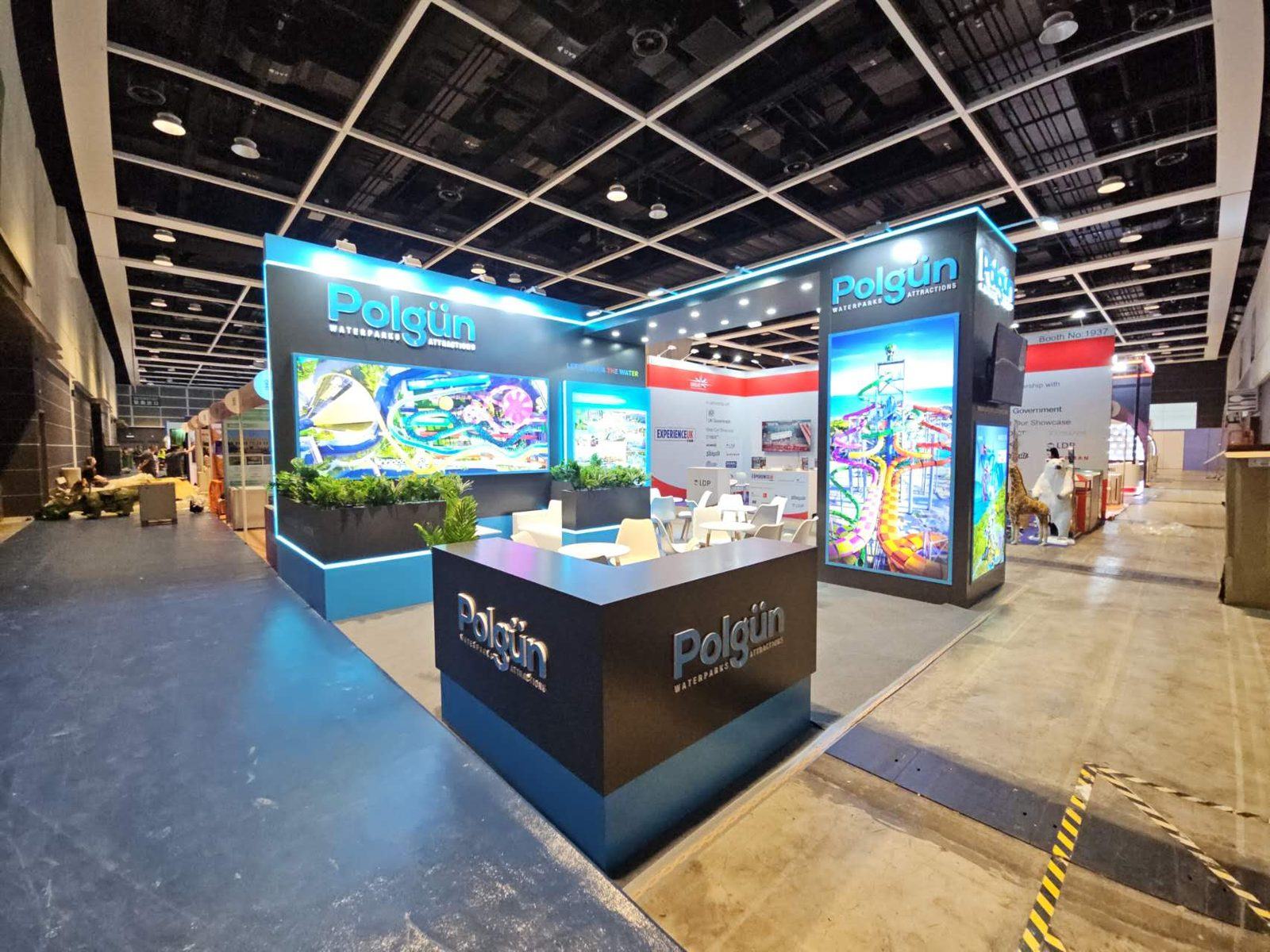
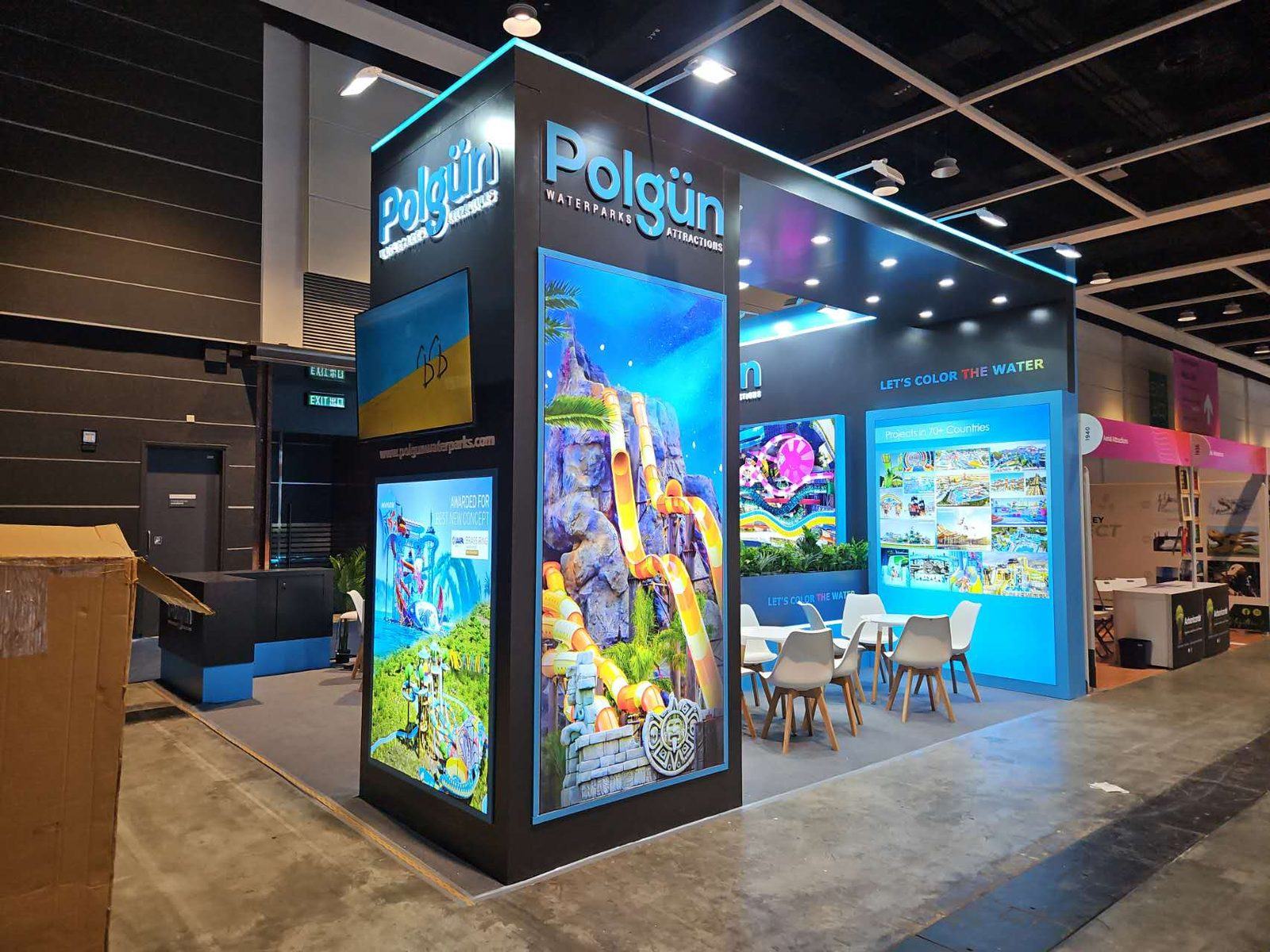
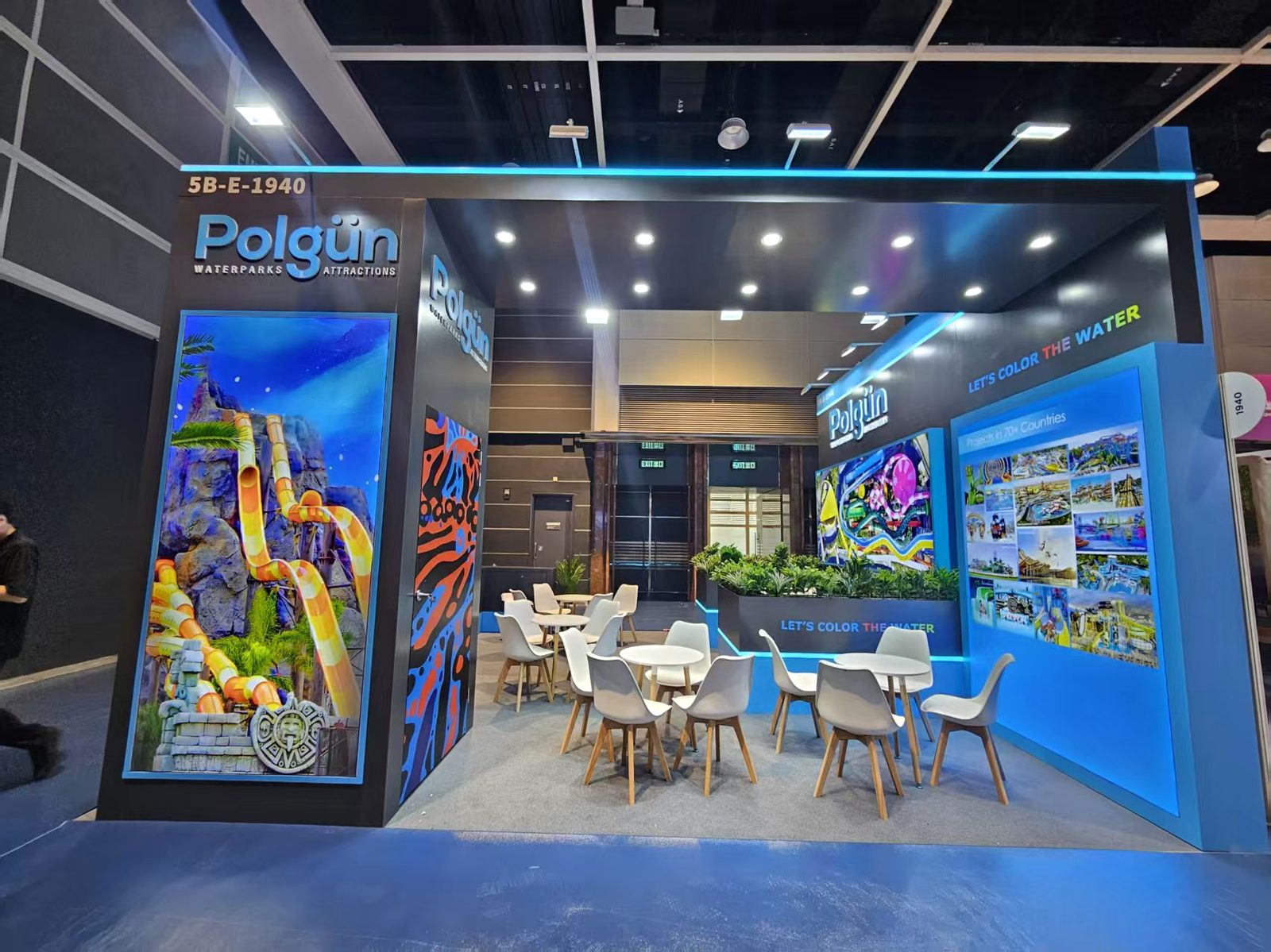
Space in Hong Kong is expensive by regional standards, so successful stands go vertical and keep the footprint working. Open-front layouts, a clearly visible meeting zone with real seating, and one strong overhead or tower element outperform wide, shallow displays. Lightbox walls and LED screens pull weight in these halls: with aisles this busy, a booth that reads clearly from fifteen metres away earns the stop, and the same screen doubles as a demo surface once visitors step in. Keep storage hidden inside the structure — compact hall storage rooms fill fast, and exhibits left in aisles are a compliance problem, not just a tidiness issue.
This is a market where local compliance experience matters as much as design skill. New Power Exhibition (NeoBooths) delivers custom booths in Hong Kong as a turnkey package — design, fabrication, structural sign-off, and on-site installation — which matters here because the approval chain (drawings, structural certification, official-contractor electrical work) runs on fixed deadlines that a visiting exhibitor cannot easily manage alone. Our past work in the city includes a 32 sqm custom stand at the 2023 Hong Kong International Lighting Fair, documented in our Hong Kong lighting fair project page. For a wider view of how mainland production feeds Hong Kong show schedules, our China trade show guide covers the cross-border logistics model.
Venue Rules Every Exhibitor Must Plan Around
Hong Kong’s exhibition rules are published, precise, and enforced, and most of them are set by HKTDC’s exhibition regulations rather than by your contractor. The ones that most often surprise international exhibitors:
- Height limits. Since 1 May 2025, all single-deck custom-built booths are capped at 4 metres (double-deck stands remain capped at 5m). Within ±0.5m of smoke curtains at HKCEC, height drops to 2.5–3m depending on location — check your hall plan before designing a tall tower.
- Structural safety certification. Any stand taller than 2.5m, or using a hanging lighting truss, needs a structural safety certificate endorsed by an Authorised Person / Registered Structural Engineer (AP/RSE), submitted by 15:00 on the last move-in day. Larger structures — 4m+ stands, trusses carrying 100kg or more, public-show stages 1.5m+ — need AP/RSE-endorsed drawings and calculations lodged with the organiser roughly seven weeks before the show opens.
- Electrical work. All on-site electrical installation is carried out by the organiser’s official contractor at the exhibitor’s expense, with design plans due about six weeks before opening. Supply is 210–230V single phase as standard, with a maximum of roughly 20kW per 15 sqm of floor area; three-phase 380V requires prior arrangement.
- Strike deadlines. Everything must be dismantled and cleared by midnight on the final show day, or overtime hall charges begin.
- Self-build rules. Overseas exhibitors or contractors building their own stands must comply with Hong Kong Immigration Department requirements — another reason most visiting brands appoint a local turnkey builder.
Booth Costs and Budgeting in Hong Kong
Start with space, because organiser rates anchor the budget. At major HKTDC fairs, published price schedules put space-only participation in the region of USD 600–750 per square metre (premium zones such as the Lighting Fair’s Hall of Aurora run higher), while turnkey 9 sqm shell-scheme packages typically start around USD 7,000. Custom construction then adds roughly USD 400–800 per square metre depending on finishes, rigging, and AV — a 24 sqm custom stand with a lightbox wall and meeting area generally lands in the USD 15,000–30,000 all-in range including build, on-site labour, and electrical. Freight into Hong Kong is comparatively cheap and duty-free (the city is a free port with no customs tariffs on exhibition goods), which softens one of the cost lines that hurts in other markets.
As a planning rule of thumb, total spend usually runs about 2.5 times your space rental once build, freight, travel, and staffing are included — the same budgeting logic we break down in our first-time exhibitor guide. Book space early for the January and April clusters: prime HKCEC halls for the Toys Fair, the two electronics fairs, and the Gifts & Premium Fair are allocated months in advance, and contractor capacity compresses around those weeks. If your programme spans the region, our turnkey booth solution page explains how one design language is reused across Hong Kong, mainland China, and Southeast Asia to cut both engineering and management costs.
Practical Tips for International Exhibitors
Logistics are Hong Kong’s quiet advantage. Exhibits enter the city without customs duties, Hong Kong International Airport sits beside AsiaWorld-Expo, and sea freight through the port clears quickly — most international exhibitors ship direct with a specialist forwarder or source graphics and consumables locally to skip customs entirely. Build your marketing for a bilingual, fast-moving floor: English carries the show, but simplified-Chinese signage helps with mainland buying delegations. Staff generously for short, high-volume conversations — buyers here work through long shortlists quickly, so script a 90-second pitch and capture leads systematically rather than trusting business cards. Commit to first follow-up within 48 hours of the hall closing, while sourcing teams are still consolidating decisions; our lead capture guide outlines the workflow. Finally, plan accommodation early during twin-show weeks — when the electronics and lighting fairs stack back to back, Wan Chai hotels fill far ahead of the opening day.
Frequently Asked Questions
How much does a trade show booth cost in Hong Kong?
Space-only rates at major HKTDC fairs run roughly USD 600–750 per square metre per published price schedules, and turnkey 9 sqm shell packages start around USD 7,000. A custom-built 24 sqm stand with lighting, a lightbox wall, and a meeting area typically lands between USD 15,000 and 30,000 all-in, excluding travel and staffing. Budget about 2.5 times your space rental for total spend.
How tall can my booth be at HKCEC?
Since 1 May 2025, single-deck custom stands are capped at 4 metres everywhere in Hong Kong’s HKTDC venues, with double-deck stands capped at 5 metres. Stands within half a metre of HKCEC smoke curtains are further limited to 2.5–3m depending on position. Anything above 2.5m, or with a hanging truss, needs an AP/RSE-endorsed structural safety certificate.
Which venue will my show be at — HKCEC or AsiaWorld-Expo?
Follow the organiser, not your preference: the venue is fixed by the show. Consumer-sourcing fairs (electronics, gifts, toys, jewellery, lighting) concentrate at HKCEC in Wan Chai, while airport-adjacent AsiaWorld-Expo hosts larger single-level events and the Diamond, Gem & Pearl Show each March. Some fairs, like the jewellery week, span both venues in sequence.
Do I need a local contractor to build my booth in Hong Kong?
You are not legally required to use one, but the approval chain — official-contractor electrical work, structural certification deadlines, and immigration rules for self-building overseas crews — makes a local turnkey builder the practical choice for nearly all international exhibitors. A local partner also handles the midnight strike deadline and venue paperwork that visiting teams rarely have time to manage.